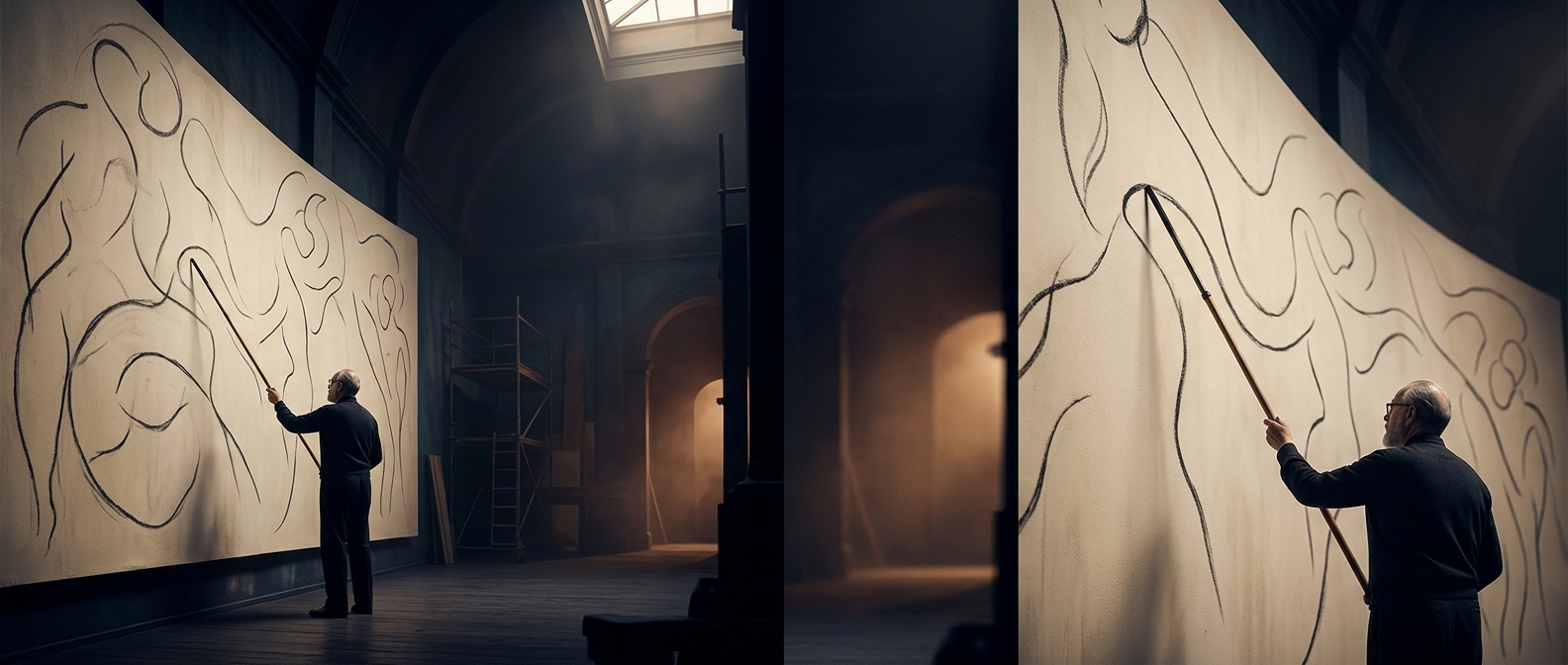
A Longer Reach for Matisse’s Charcoal
As illness limited Matisse’s mobility, drawing on a wall became a practical problem: the surface was large, but he could no longer move freely across it. His solution was to fasten charcoal to a long bamboo pole and work from his chair. If a section remained beyond reach, he lengthened the tool.
The pole did more than spare him from standing. It let him make a mark far from his body, turning a small seated workspace into access to a much larger field. But a longer tool also made fine control harder: every movement of the hand had to travel down the pole to the charcoal tip. Drawing at that scale therefore called for deliberate, sweeping gestures rather than the close, wrist-led marks of a small sketch.
The Wall as a Working Surface
A wall offered room to develop a composition at a scale that paper could not easily provide. Charcoal was useful because it left a visible line without requiring paint or a permanent commitment; marks could be changed as the drawing evolved. Working directly on the wall also let Matisse judge the whole arrangement from a distance, then move closer—within the reach of his improvised tool—to adjust parts of it.
The image of the artist seated below a drawing that rises beyond his reach makes the method seem like a workaround. It was that, but it was also a way to keep working at monumental scale: when his body could not cross the studio, the bamboo pole carried his hand across the wall.