A mistranslation became a feature of Moses
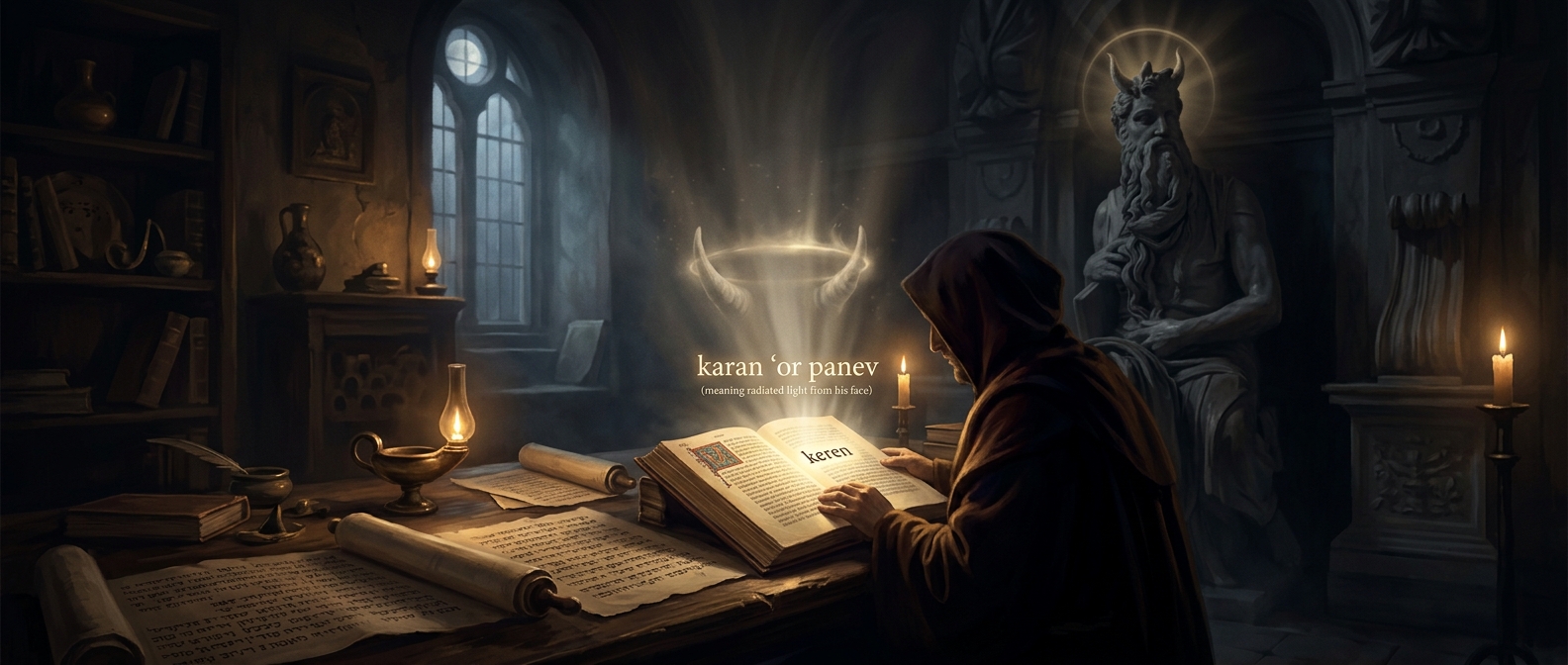
Michelangelo’s horned Moses grew out of a translation choice made centuries earlier. In the biblical account, Moses descends from Mount Sinai after speaking with God, carrying the tablets of the law. The Hebrew text describes his face as radiant—shining with reflected divine glory.
When Jerome translated the Bible into Latin in the late fourth century, he rendered the key Hebrew word as cornuta, meaning “horned.” The wording could be understood as describing rays or projections of light, but in Latin it also gave a straightforward image: Moses had horns.
Why the image lasted
Jerome’s Latin Bible became the standard scripture for much of Western Europe. Artists and readers encountered Moses through that text, so horns became a familiar visual shorthand for the passage. They could signal that Moses had been marked by contact with God, even when the underlying idea was radiance rather than literal horns.
By the time Michelangelo carved his Moses in the early 16th century, the horned interpretation had a long artistic history. He followed the wording and convention his audience would recognize. The sculpture’s horns are small and integrated into the figure’s head, not presented as a monstrous feature.
The result is a striking example of how translation can shape what people picture: a word meant to convey brightness left Western art with a Moses whose divine encounter is visible as a pair of horns.