In Las Meninas, the painter steps into the court
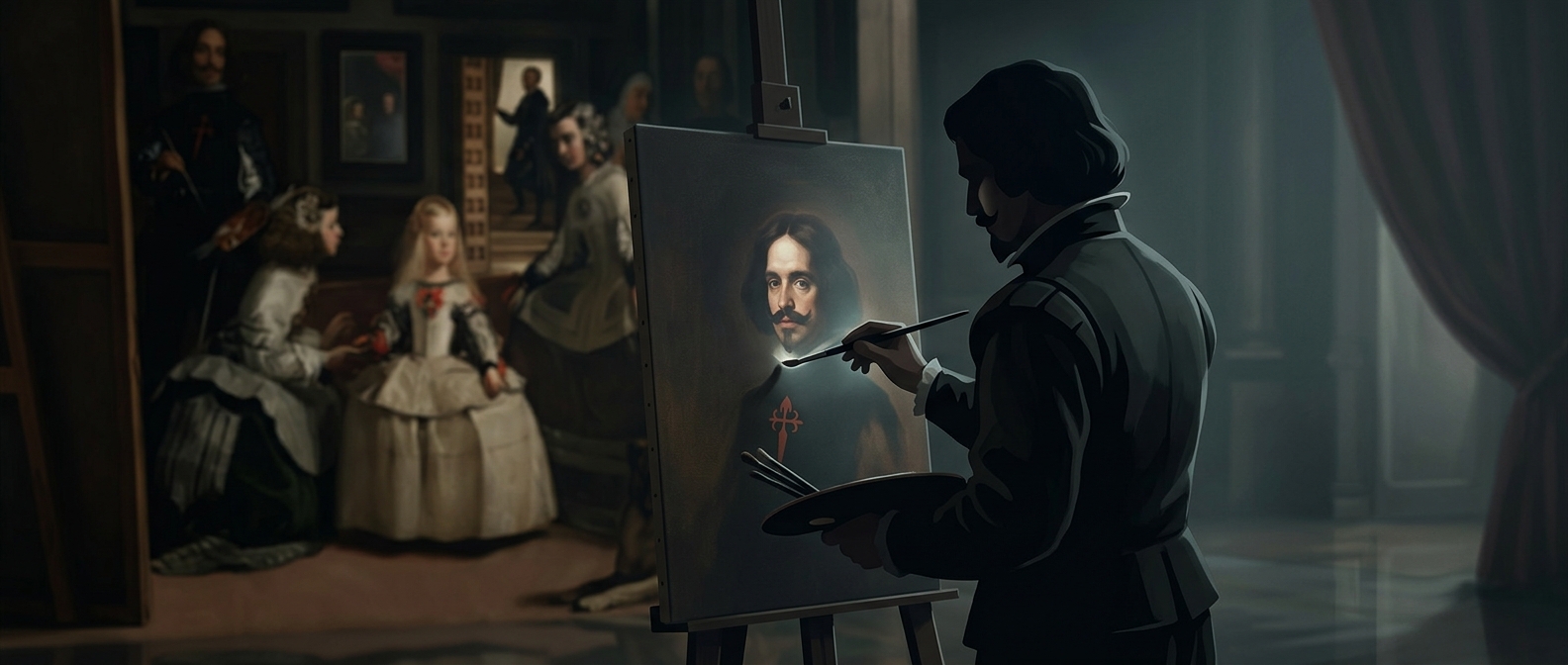
In Diego Velázquez’s Las Meninas, painted in 1656, the artist appears at the left beside a large canvas, brush in hand. Around him are the young Infanta Margarita, her attendants and other members of the royal household. A mirror at the back of the room reflects King Philip IV and Queen Mariana, though the painting leaves open exactly where they stand in relation to the scene.
That arrangement makes Velázquez more than a face hidden in a crowd. He is shown doing the work that gives the royal family its public image, while the king and queen appear only as reflections. The canvas he is painting is turned away from us, so we cannot see what he is making—or fully settle how we, the viewers, fit into the room.
A portrait of work and status
Velázquez was not an outsider peeking into court life. As the king’s painter, he had unusual access to the royal household, and his job depended on representing its members. By including himself at work among them, he made the painter’s presence part of the subject: court life was being observed and shaped into an image at the same time.
The scene also draws attention to the status of that work. Velázquez stands upright and occupies substantial space, not tucked away as a servant. His self-portrait invites viewers to notice the artist as a skilled professional with a place in the court’s world. The king’s reflected presence and the painter’s visible hand make a striking pair: one holds political power; the other controls what the picture allows us to see.