The brain estimates speed from changing views
When you move through a visible space, nearby objects sweep across your field of vision faster than distant ones. This pattern, called optic flow, gives the brain a strong clue about how quickly you are traveling. A wall of scenery rushing by can make a modest movement feel dramatic; a distant, steady horizon can make motion seem calmer.
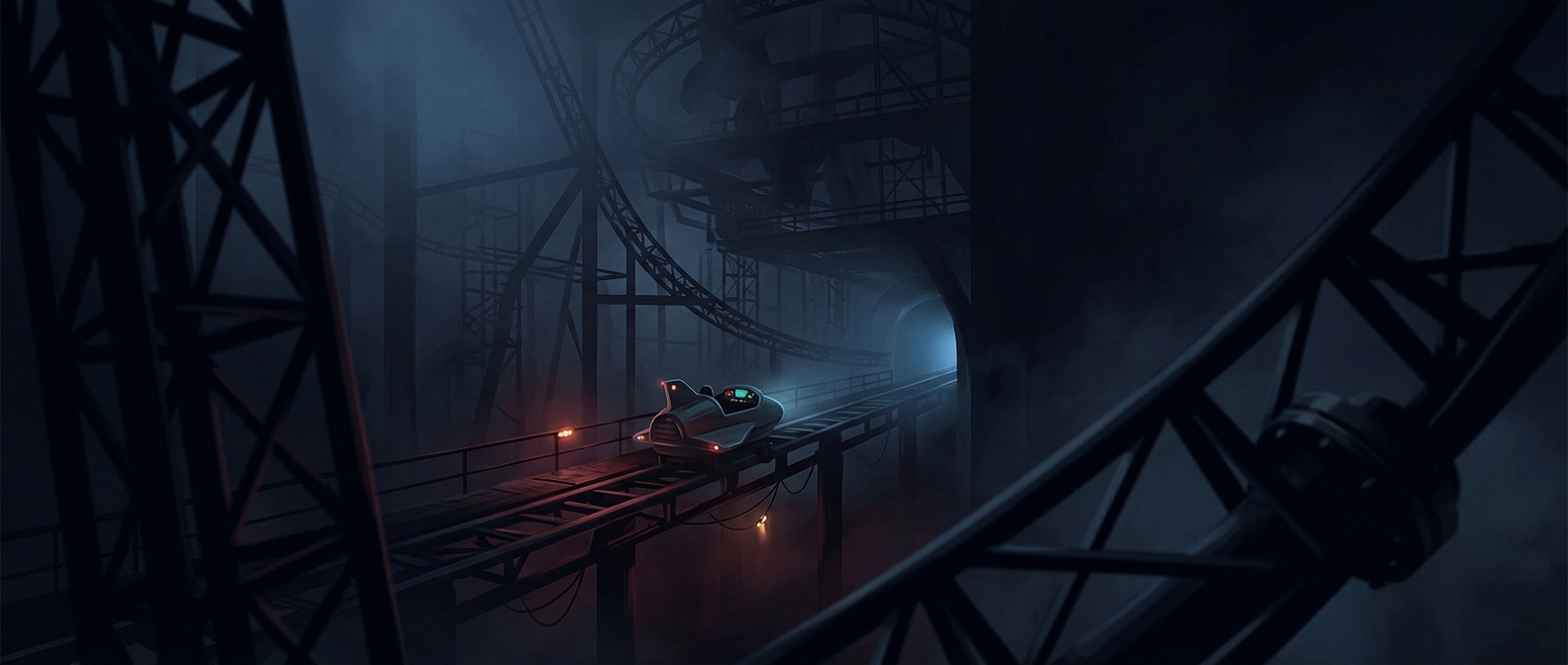
Inside a dark ride, those visual landmarks are scarce. The brain has less information to compare from moment to moment, so it leans more heavily on signals from the body: pressure against the seat, a shift in balance, and the pull of a turn.
Turns become the main event
A coaster’s curves and changes in direction produce forces your body can feel even when you cannot see the track. Your inner ear senses changes in motion, while your body registers where it is being pushed or supported. A quick turn in darkness can therefore feel abrupt and hard to predict: there is little visual warning to prepare you for what comes next.
The unknown also matters. If you cannot see the curve approaching, you cannot easily judge its size or duration. That uncertainty can make each movement feel more intense, even though the ride’s physical speed has not increased.
A different kind of speed
The effect is not that darkness creates extra acceleration. It changes the evidence your brain uses to interpret the ride. With the track and scenery hidden, a bend is no longer a shape you watch coming toward you; it is a force that arrives through your seat and body. That is why a coaster can feel surprisingly fast without changing how fast it actually travels.