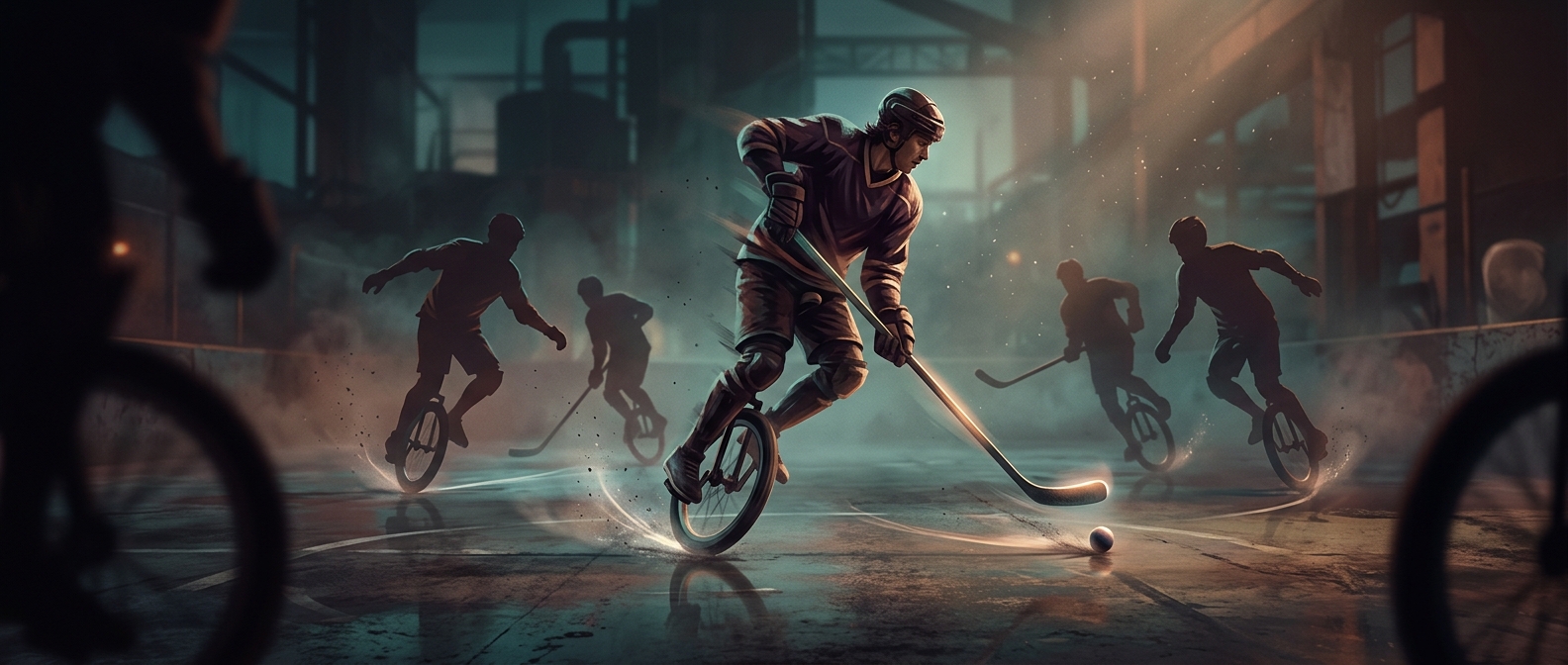
Why the unicycle changes the game
A unicycle has no handlebars to steer with. Riders guide it by shifting their weight and changing how hard each pedal turns the wheel. That makes a quick hockey move a whole-body adjustment: lean and pedal to accelerate, ease off or pedal backward to slow, and shift your balance to curve around another player.
The puck adds a second task. A player has to control the stick with one hand while using the other for balance, often making small corrections through the pedals at the same time. A reach that would be simple on skates can pull a rider off line if their torso moves too far. The challenge is not just staying upright; it is staying upright while placing the wheel exactly where the next play requires.
Momentum is part of the equipment
On a unicycle, the wheel is the only support, so the rider cannot coast in quite the same way as someone standing on a stable platform. Pedaling helps maintain balance as well as movement. When the rider wants to stop, turn, or recover from a stumble, the timing of those pedal strokes matters. The stick, meanwhile, reaches beyond the wheel and can tempt a player into leaning farther than the machine can support.
This creates a distinctive tradeoff: a fast approach can help a player reach the ball, but speed makes a sudden change of direction harder. Skilled play depends on controlling momentum before the stick makes contact, not merely reacting after the ball moves.
A different kind of team coordination
Because every player is managing that balance-and-movement loop, positioning matters. A teammate can create space by drawing opponents away, while a player with the ball needs room to turn without colliding or losing control. The result is hockey in which a successful pass depends on more than aim: the receiver must also be able to steer into it.
The unicycle is not a novelty attached to ordinary hockey. It changes the route to every ordinary hockey skill—accelerating, defending, and turning—because the player’s body is also the steering system.