How a Black Hole Makes Light Take the Long Way Around
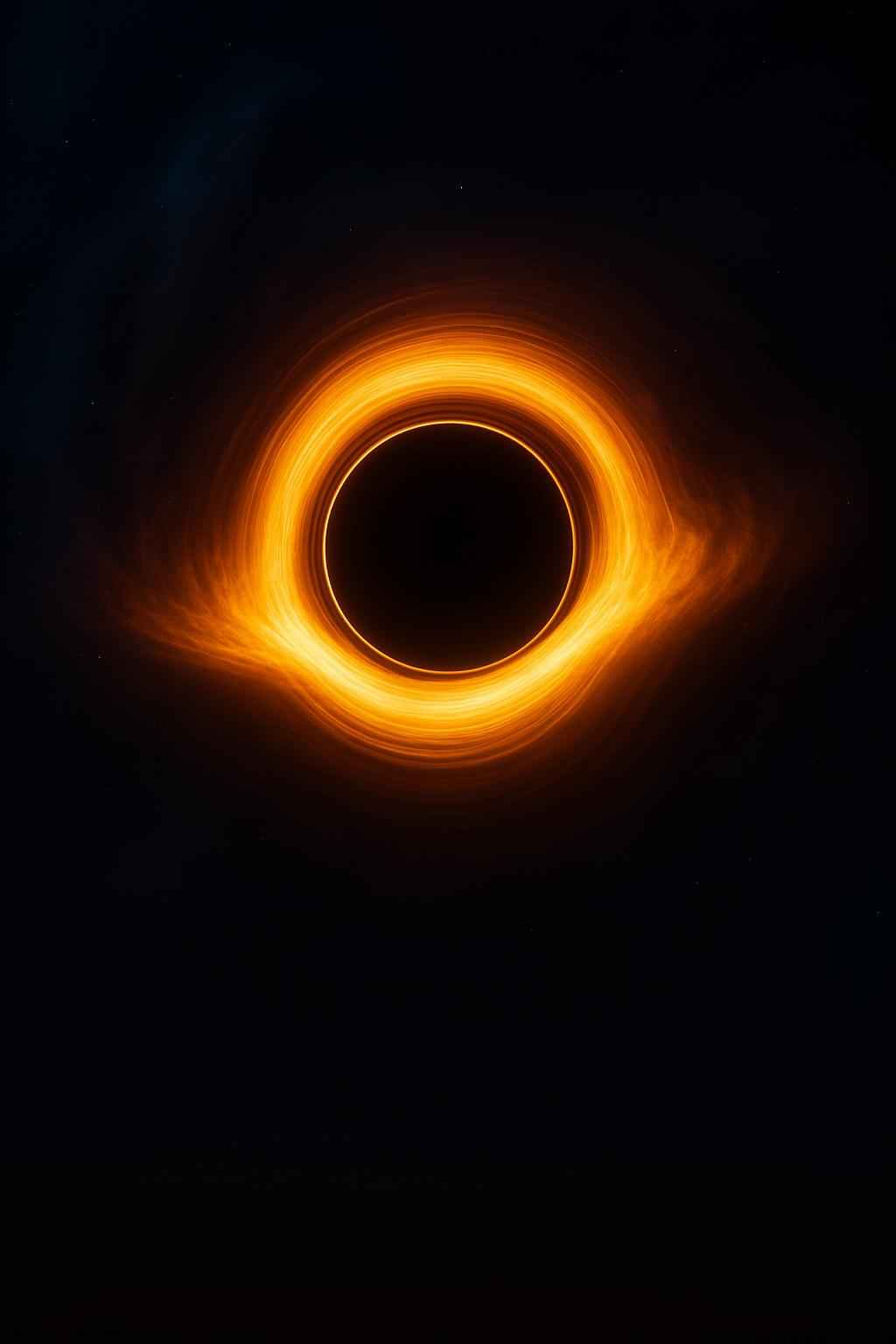
A black hole’s gravity can bend a passing ray of light, much as a massive lens redirects light from a distant object. Close enough to the hole, that bending can send light onto a curved path that swings around it before heading outward again. From far away, the ray appears to have come from a direction different from its true source.
Some rays pass the black hole and escape after a modest bend. Others skim closer to a special boundary called the photon sphere: a region where gravity can, in ideal conditions, keep light circling the hole. Those paths are unstable. A tiny change in a ray’s route can make it fall inward or escape, but a ray that passes just right can travel around the hole one or more times before getting away.
Why the Rings Get Fainter
An observer sees these curved routes as images, not as bands of matter orbiting the black hole. Light from the same background source can reach us along several paths: one relatively direct, another that loops around once, and others that make additional turns. Each extra loop produces another, more tightly placed image near the black hole’s apparent edge.
The paths that loop many times occupy an increasingly narrow range of possible routes. They also tend to be faint: the light is spread across thin image features, and much of the surrounding material may obscure or outshine it. So the extra images form a sequence of progressively dimmer rings rather than bright, solid hoops.
The striking consequence is that the black hole can show us the same background light along different histories. A ray that appears near the edge may have taken a much longer, more tangled journey than one arriving from farther out—and the rings are the visible record of those detours.