Why a Tugboat Needs a Crushable Buffer
A tug’s job often brings it alongside ships many times its size. It may push against a hull to help turn or position the vessel, or hold close while working in tight water. Without protection, a small change in angle or motion could press steel against steel, risking damage to both boats.
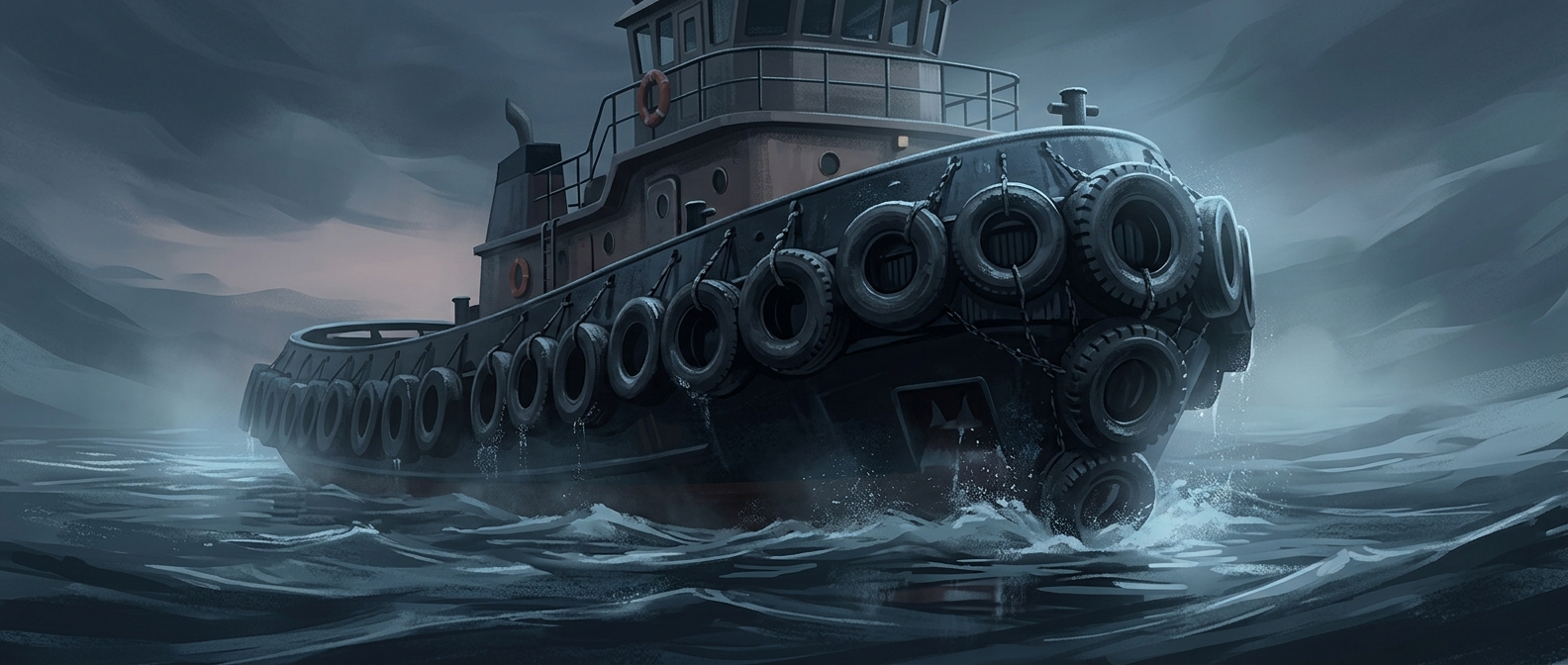
A tire fender gives that contact a softer first point. When squeezed, the tire’s rubber bends and its hollow interior collapses, absorbing some of the impact and spreading the force across a broader patch instead of concentrating it at a sharp edge.
How Old Tires Become Fenders
Used tires are durable, readily available objects that can be fastened around a tug’s sides as protective bumpers. Their bulk creates a stand-off distance between the tug’s hull and the larger vessel. If contact occurs, the tires compress before the hulls can meet directly.
The buffer is useful because a tug needs to make controlled contact, not avoid contact altogether. Its crew can bring the boat in gently and use pressure against the other vessel while the fenders cushion the surfaces. The tires do not eliminate the force of a push; they help manage it.
A Simple Device With a Working Limit
Tires are practical, but they are not indestructible. Repeated squeezing, scraping, and exposure to water and weather wear them down, so their attachment and condition matter. They also cannot make a hard or badly angled collision harmless.
That is why the tire’s role is modest but important: it acts as a replaceable, deformable layer between two expensive hulls. In close-quarters ship handling, that bit of give can turn routine contact into a controlled maneuver rather than a damaging blow.