Turning hand motion into travel
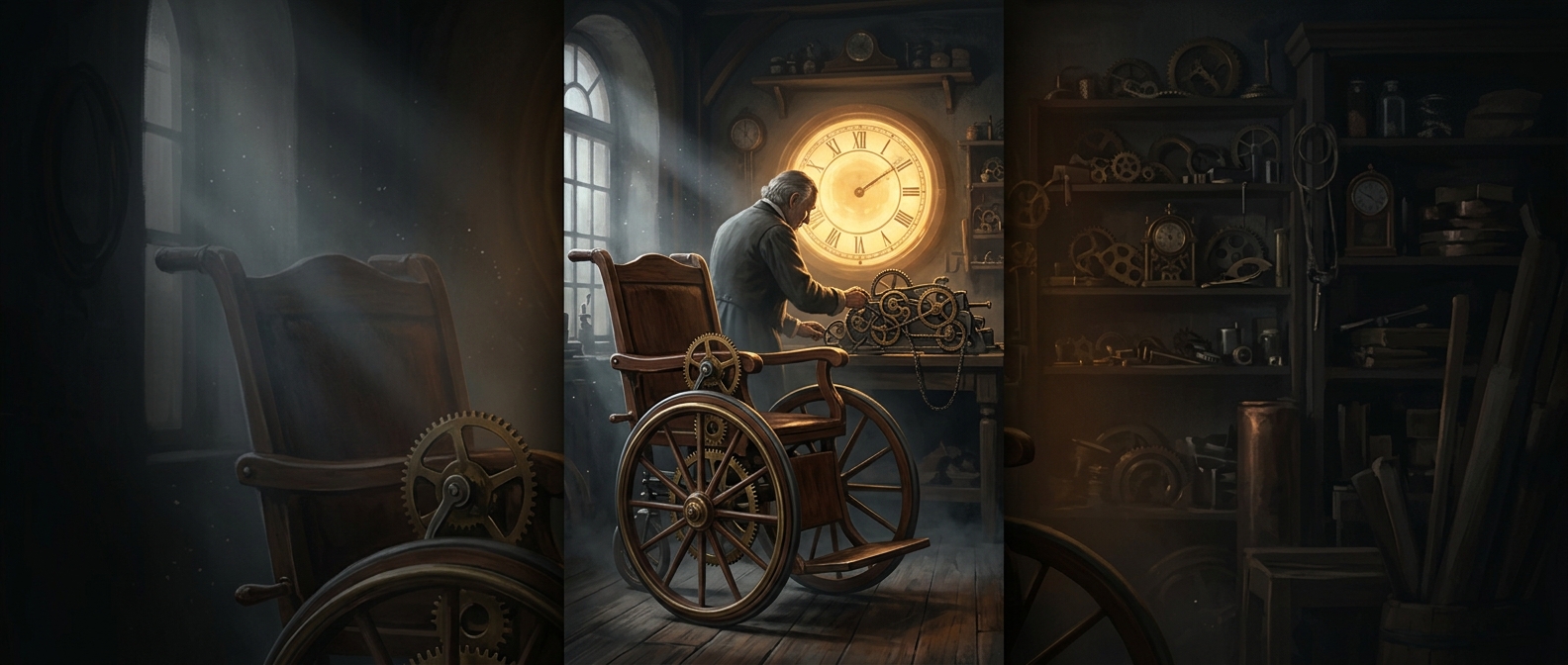
Stephan Farffler’s chair translated a familiar mechanical idea into a practical form of mobility. Turning a hand crank produces rotation; gears pass that rotation along and can change how quickly the wheels turn relative to the crank. In this case, the mechanism let Farffler propel the chair himself rather than rely on a person behind it.
That is a different problem from simply making a chair roll. A person pushing from behind supplies force at the chair’s back, while a hand-cranked design puts the user in control of the drive. Each turn of the cranks could move the wheels, making the user’s own effort the link between intention and movement.
A clockmaker’s kind of solution
The chair’s three-wheel layout and geared drive made it a compact mechanical system, not just a seat fitted with wheels. Gearing is useful because it connects a small, repeated movement of the hands to the larger task of moving a vehicle. The design also brought a tradeoff: travel depended on the user’s ability to keep turning the cranks, rather than on a companion’s ability to push.
Farffler’s invention mattered because it made mobility more self-directed. Its central idea is still easy to recognize: put the power source within reach of the person using the vehicle, then use mechanical transmission to carry that effort to the wheels.