Why a guard’s suspicion has a short memory
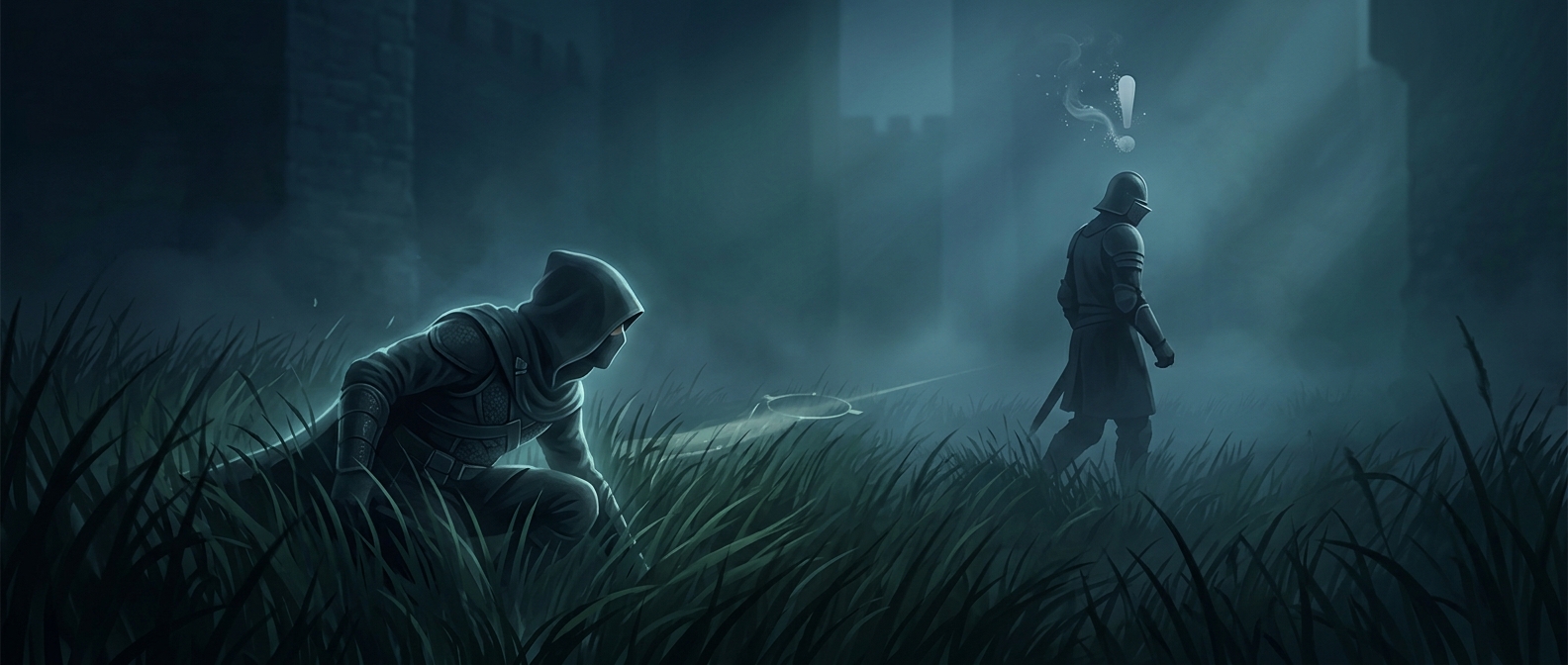
A stealth-game guard usually does not reason about danger the way a person would. The game tracks a simplified set of signals—perhaps a sound, a glimpse of the player, or a discovered body—and moves the guard through behavior states such as patrol, investigate, and search. Each state has rules, and the search state often comes with a timer or a suspicion level that gradually falls.
That decay is a design choice. If one faint noise kept a whole area on alert indefinitely, a player could lose the chance to recover from a small mistake. Letting suspicion fade gives the player a readable window: stay hidden while the guard checks the disturbance, and the normal patrol resumes.
The world runs on rules, not continuous attention
A guard’s awareness may also be divided into separate checks. The game might register that a body was found, for example, without making every nearby guard continuously reconsider every body they pass. Those checks cost development time and computing resources, and they can create unpredictable behavior that is hard for players to understand. A simple, consistent rule set is easier to tune—and easier to learn.
The tradeoff is that the simulation can look absurd. A guard may finish searching, return to a route, and ignore evidence that would keep a real person concerned. But that reset is often what preserves stealth as a playable loop: the player can make a mistake, wait out the search, and try again. The moment a guard steps over a fallen colleague is funny because it exposes the boundary between the character’s human appearance and the game’s much narrower attention system.