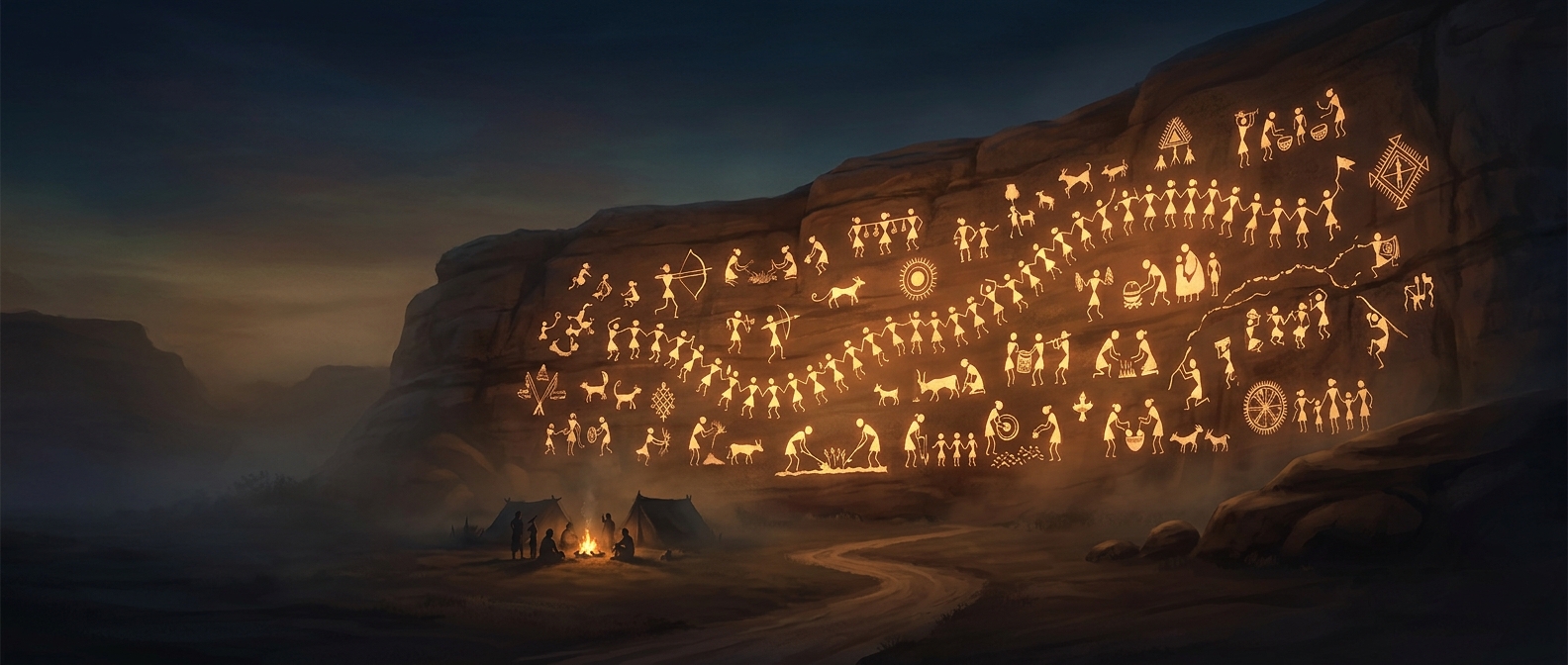
How Warli figures make a whole community visible
Warli painting, associated with the Warli people of western India, builds scenes from a deliberately spare visual vocabulary. A human figure is often made from two triangles meeting at a point, with lines for arms and legs. The simple shape can show a person bending, carrying, dancing, or working; repeated across a wall, those gestures become a record of shared activity rather than portraits of individuals.
The figures are not arranged to imitate a view from one fixed spot. There is no distant horizon or vanishing point to tell the eye what is near and far. Instead, repetition and placement show how people relate: dancers form a ring, workers gather around a task, and hunters move through a landscape alongside animals. The composition is less a window onto one moment than a map of actions that belong together.
A wall painting tied to lived occasions
Traditionally, Warli paintings were made on the earthen walls of homes, often for important occasions. The contrast between the wall’s reddish-brown surface and the white paint made from rice paste gives the scenes their clarity. Their materials also connect them to the household: the image is made directly on the place where people live, not on a separate canvas meant to be viewed elsewhere.
That setting helps explain why ordinary work and celebration can sit side by side. A painting can bring together farming, animals, music, and dance without ranking one as background and another as the main event. Its organizing principle is participation: the community becomes visible through what its members do together. A circle of dancers, for example, does not need a distant viewpoint to convey the scene; the repeated figures make the shared movement unmistakable.