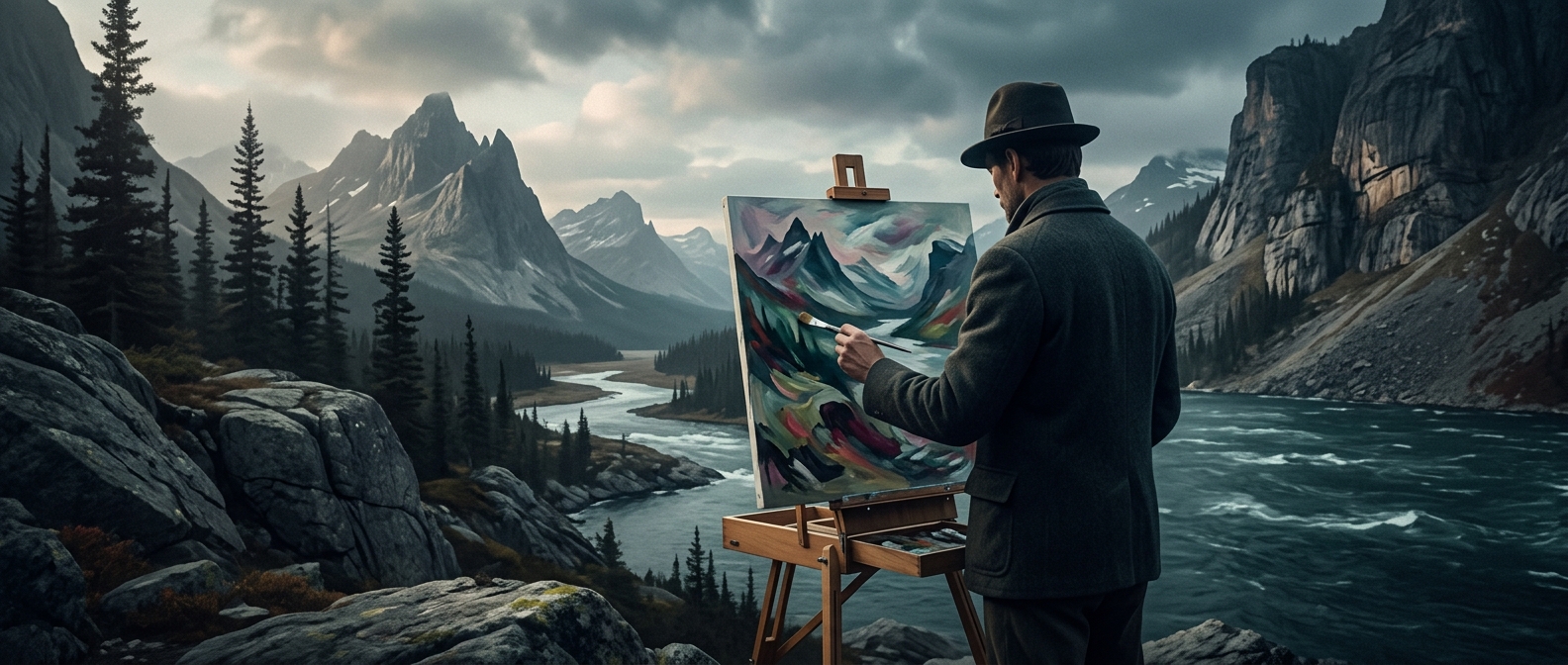
The landscape had to be caught between weather changes
Painting in the Canadian wilderness meant working against conditions that could alter a scene before an artist finished. Cold stiffened hands; insects made stillness difficult; and shifting light changed the color and shape of shadows across rock and trees. The artists could not simply settle into a comfortable studio routine and expect the landscape to wait.
That pressure favored a practical approach: make quick studies outdoors, recording the arrangement of land, trees, and light while it was in front of them. A study is a working sketch, not necessarily a finished painting. It could preserve a visual impression that would later be developed into a larger work indoors.
Rough country, deliberately composed
The Group of Seven did not treat wilderness as a neutral backdrop for people or buildings. Their paintings made the land itself the subject. Jagged rock faces, bent trunks, and dense stands of pine could be simplified into strong shapes and lines, giving the scene an order that felt designed without making it look tame.
This was a choice, not just a record of what happened to be nearby. In the early 20th century, the artists were helping make Canadian landscape painting feel distinct from inherited European models. Working directly from the terrain gave their images a physical immediacy; reshaping what they saw gave that experience a force a literal transcription might not have had.
The hardship became part of the method
The woods were difficult places to work, but that difficulty also limited how long an artist could linger over detail. Instead of smoothing every tree and rock into a polished, conventional scene, the paintings could preserve the landscape’s abrupt edges and irregular growth. What began as a practical response to weather and terrain became part of the visual language: the country looked rugged because the artists had encountered it as rugged.