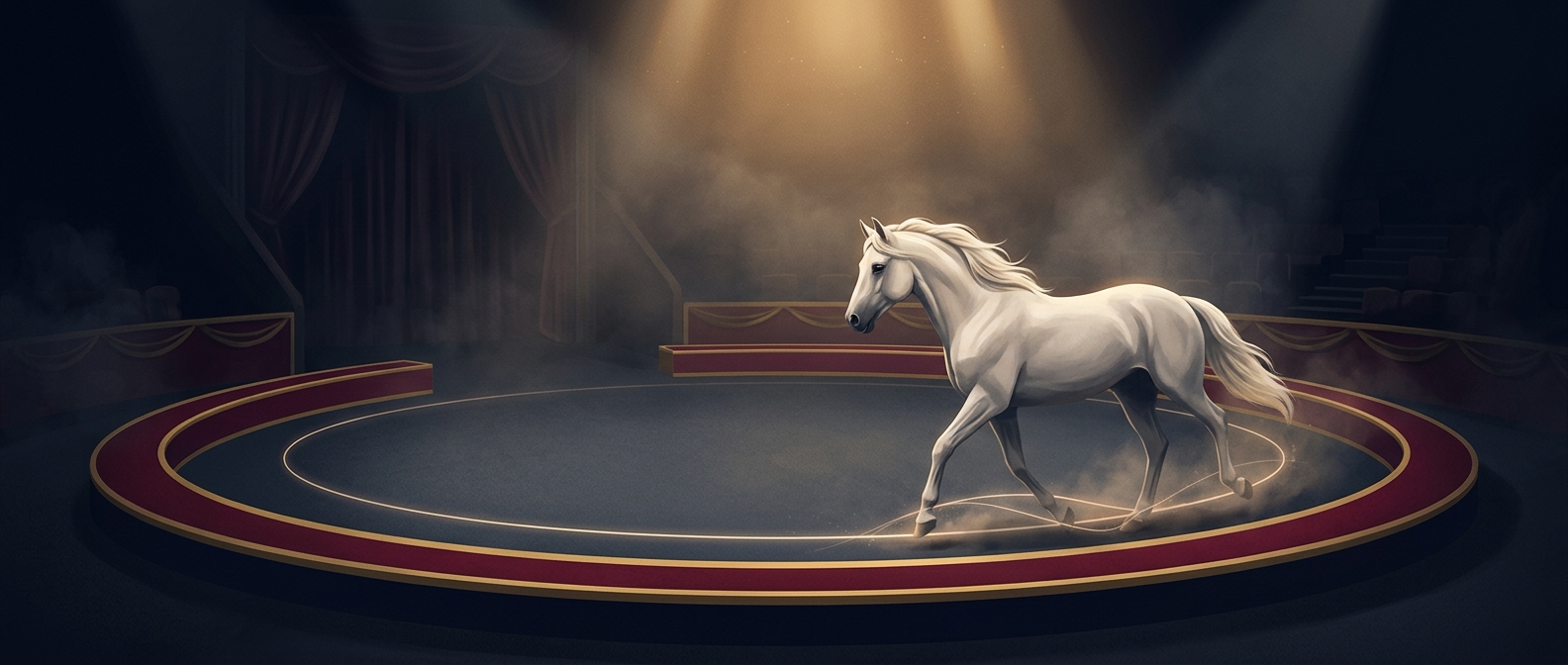
The circle becomes part of the act
A trick rider standing on a galloping horse is balancing on a moving, turning surface—not simply on a horse running straight ahead. As the horse circles the ring, it continually changes direction. The horse leans inward to make that turn, while the rider feels an apparent outward pull, often called centrifugal force. That pull can help the rider counterbalance and hold a pose.
The effect depends on both speed and the tightness of the turn. In simple terms, a faster gallop or a smaller circle produces a stronger sideways force. The ring therefore has to be small enough for the turn to matter, but not so small that the horse must negotiate an impractically sharp curve at speed.
Why ring size matters to the performance
Circus rings settled on a size that gives riders a useful combination of speed and curvature. The circular path creates a steady sideways pull throughout the act, rather than the changing forces a rider would face while weaving through turns. That predictability gives an acrobat a better chance to time a stand, pose, or other trick.
The force does not hold a rider upright by itself. The horse’s movement, the rider’s balance, and precise timing still do the work; the circle supplies a consistent physical condition to work with. The ring is not just a boundary for the audience—it is part of the apparatus. Change its size, and the same gallop can feel markedly different under a rider’s feet.