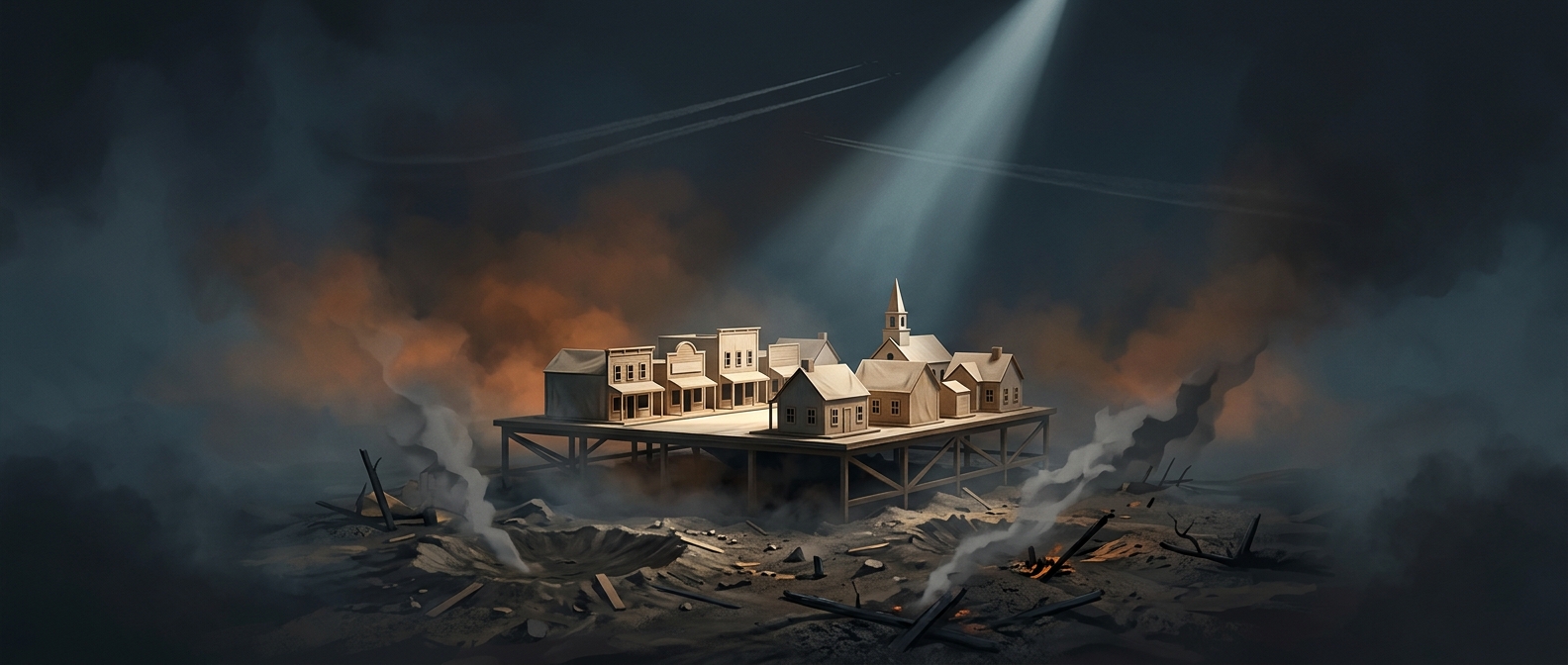
A neighborhood turned into a test instrument
Survival Town was designed to make an atomic blast legible in ordinary terms. Instead of measuring only pressure and radiation with instruments, the test put the explosion’s effects into a familiar setting: houses, furnishings, food, and human-shaped stand-ins.
That setup mattered because a blast does not affect every building—or every room—in the same way. Distance from the detonation, the strength of the shock wave, and the construction of a house all shape the damage. Furnished homes gave observers a way to see how those forces played out among walls, windows, and household objects. Mannequins made the scene more concrete without exposing people to the blast.
A demonstration with a public purpose
The test took place at Nevada’s nuclear testing grounds during an era when officials were trying to understand what an atomic attack could mean for American communities. A staged neighborhood translated an immense, unfamiliar weapon into a question people could picture: What would happen to a house like mine?
But the demonstration also had limits. A prepared test site could show damage under its particular conditions; it could not reproduce every combination of terrain, building design, blast distance, or human response found in a real city. Its value was in making the effects visible—not in offering a universal forecast.
The striking choice was to use a home as the measuring scale. The blast’s consequences were recorded not just as forces on instruments, but as a living room, a kitchen, and the figures placed where residents might have been.