Why a Container’s Wheels Go Elsewhere
A shipping container can travel by ship, train, or truck, but it needs a different kind of support on the road: a chassis, the wheeled frame that lets a tractor haul it. At the Port of Los Angeles, trucking companies can draw chassis from shared pools rather than each keeping enough equipment on hand for every possible job.
Sharing reduces the need for each company to own and store a large private fleet. It also separates the container’s journey from the journey of the frame beneath it. A container may arrive at one terminal while the available chassis are parked at another, or the chassis may be attached to a container that is headed somewhere else.
The Port’s Hidden Repositioning Work
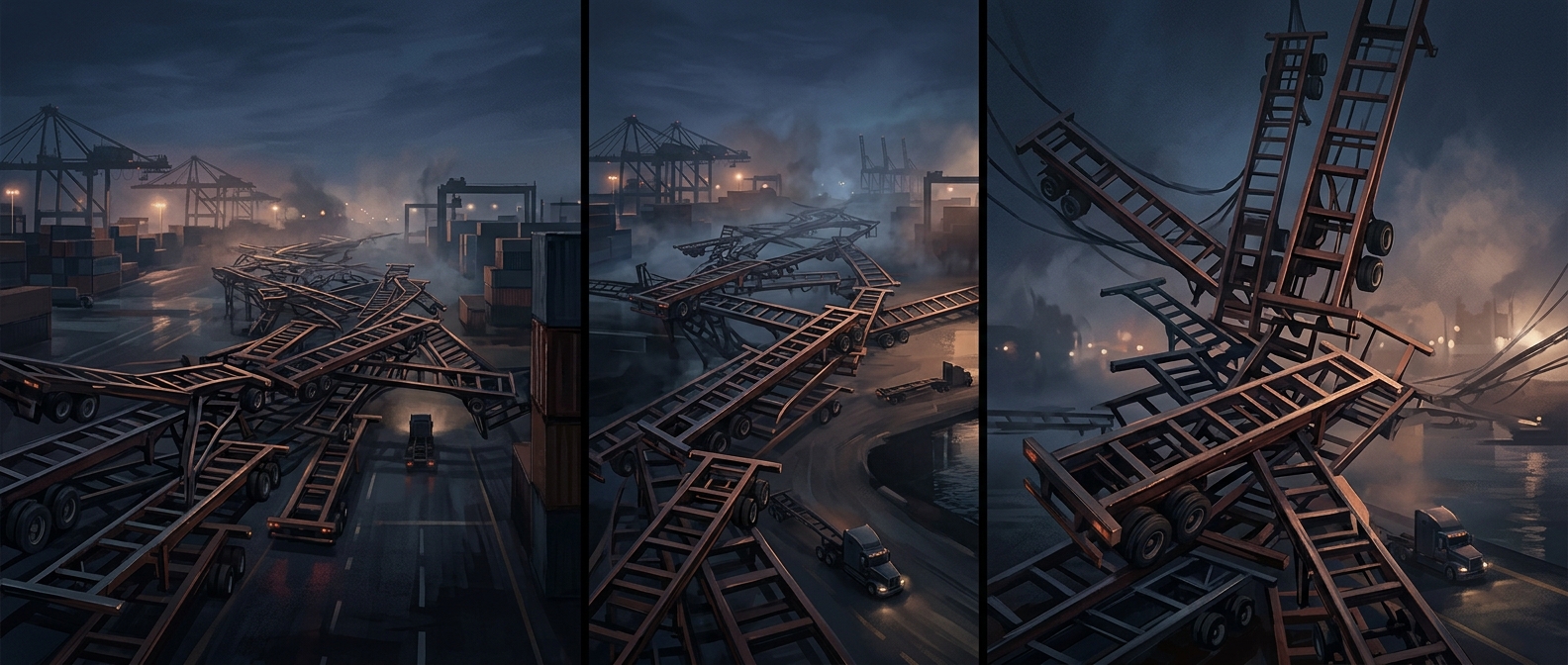
That mismatch creates extra moves. Dispatchers and trucking companies have to find usable chassis, arrange pickups, and sometimes shift empty frames to where the next load will need them. The equipment is shared, but it is not automatically in the right place at the right time.
A chassis pool therefore works less like a fixed parking lot and more like a circulating supply. Each truck trip changes where equipment is left behind, while incoming containers create new demand at particular terminals. Keeping freight moving depends on matching those shifting locations, not simply on having enough frames in total.
The Tradeoff Behind the Shuffle
Shared pools can make chassis available across more trucking operations, but they also make coordination crucial. A delay in locating a frame can hold up a container even when the ship has unloaded it and a truck is ready. The port’s bottleneck may be not the container itself, but the rolling platform it needs for the next leg.