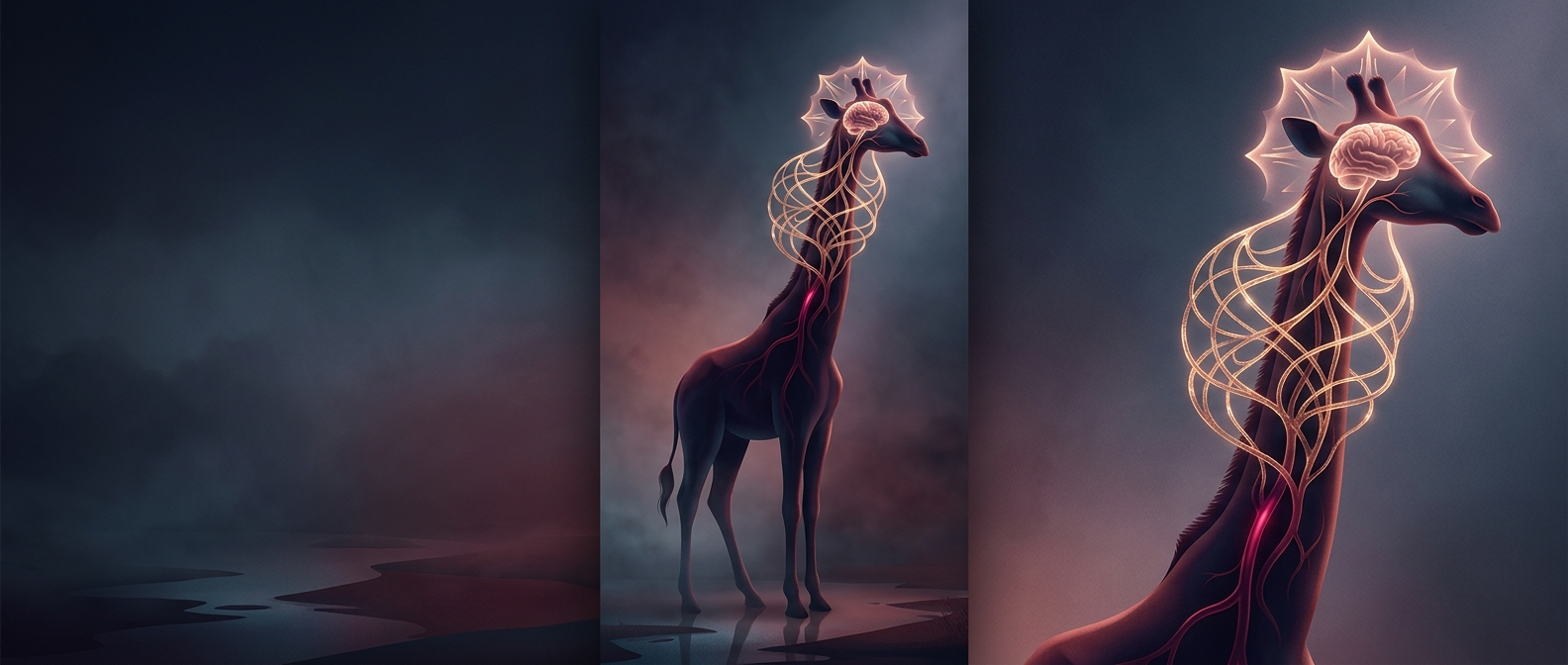
A pressure-control system in the giraffe’s head
Blood has to climb from a giraffe’s heart to a brain several meters higher. To push it uphill, the heart generates unusually high blood pressure. But when the giraffe lowers its head to drink, gravity changes the situation: blood can move downward toward the brain, raising the risk of a sudden pressure surge.
The body manages this with more than one safeguard. One important structure is the rete mirabile—Latin for “wonderful net”—a mesh of small blood vessels near the brain. Instead of letting a change in pressure travel straight through one large vessel, the mesh spreads the flow across many narrow pathways. That helps soften abrupt swings, much like a shock absorber cushions a jolt rather than stopping movement altogether.
The head-down moment
When a giraffe bends to drink, blood pressure in vessels around the head changes as the distance and height between the heart and brain shift. The rete helps buffer those changes, while other features of the circulation—including vessels that can constrict or expand—also help regulate blood flow. The system has to work in both directions: maintain enough pressure to supply the brain when the head is raised, then limit excess pressure when it is lowered.
This is not a simple matter of having a powerful heart. High pressure is useful for reaching the brain, but uncontrolled pressure could damage delicate vessels. The giraffe’s circulation therefore balances delivery with protection across a dramatic change in posture.
A built-in compromise
The rete mirabile does not act as a sealed valve or drain; it is part of a living network through which blood continues to flow. Its value lies in helping smooth pressure changes along a route where gravity matters unusually much. A giraffe can lower its long neck to drink without requiring its brain’s blood supply to endure the full force of a sudden shift.