A flowing model of change
A differential equation describes how a quantity changes, rather than merely stating its value. It can represent, for example, how heat spreads through a mass of concrete over time. Solving such an equation by hand could be laborious, especially when several changing quantities affect one another.
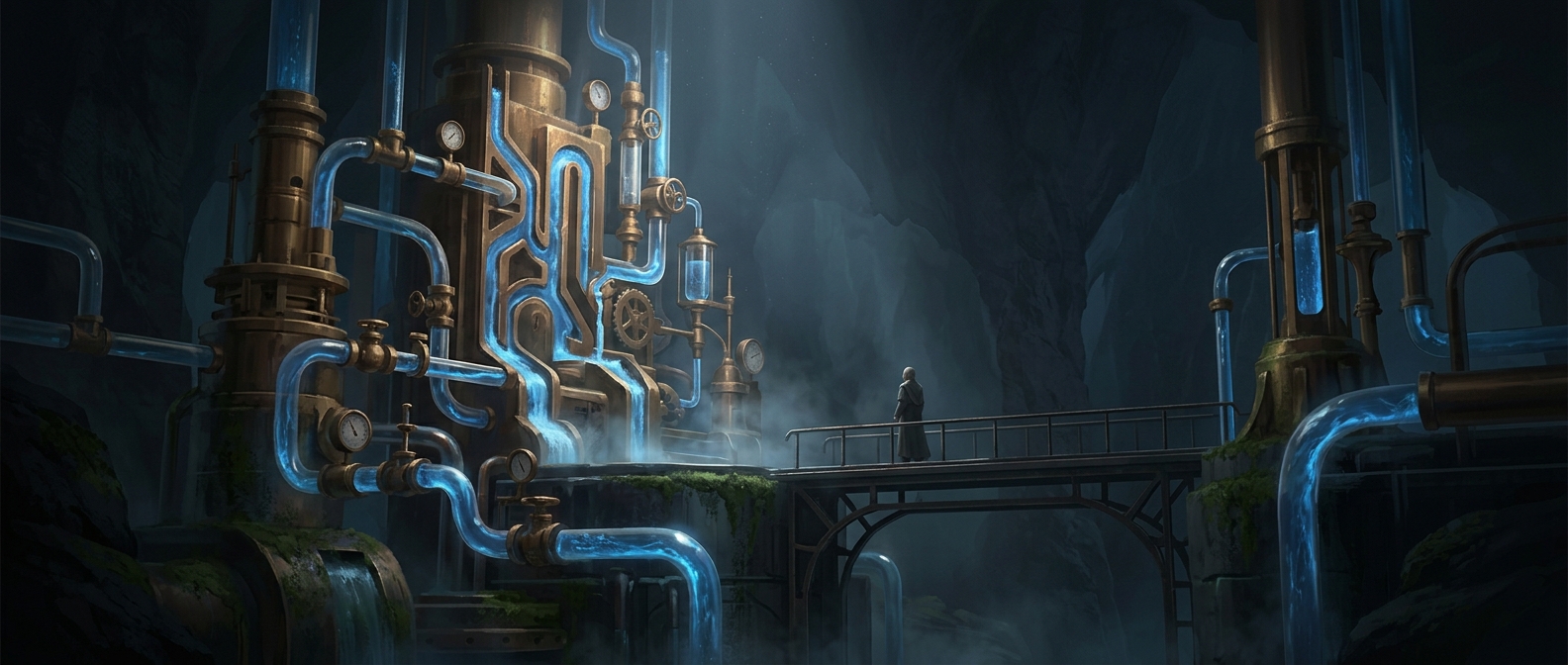
The Soviet device built in 1936, often called a hydraulic integrator, turned that mathematical problem into a physical one. Its pipes and connected vessels were arranged so water could flow between them. The water levels stood for changing quantities in the equation; the way water moved through the system represented how those quantities changed.
How water did the calculation
Water pressure depends on its height, so a difference in water level can drive flow through a pipe. Pipe dimensions and connections shape that flow. As water enters or leaves a vessel, its level rises or falls—effectively accumulating the effects of earlier flow. That makes the setup useful for representing integration, the mathematical operation that tracks how small changes add up over time.
To model a problem, the device’s hydraulic layout and settings had to correspond to the relationships in its equations. Once water moved through the apparatus, its levels provided a physical result that could be read and translated back into the problem’s quantities. It was not a general-purpose machine that understood any equation: the problem first had to be encoded in the hardware.
From equations to engineering choices
The approach was suited to problems involving gradual change, including heat moving through curing concrete and shifts in geological layers. Instead of calculating every step numerically, engineers could observe how the linked water levels evolved as a system. That made a difficult mathematical relationship tangible—and gave them a way to explore how changing conditions might affect a real structure or section of ground.