Turning a brief delay into a visible change
Light crosses even a long laboratory-scale route too quickly for a person to time directly. Fizeau’s key move was to make that tiny travel time show up as a change in whether the returning beam could be seen.
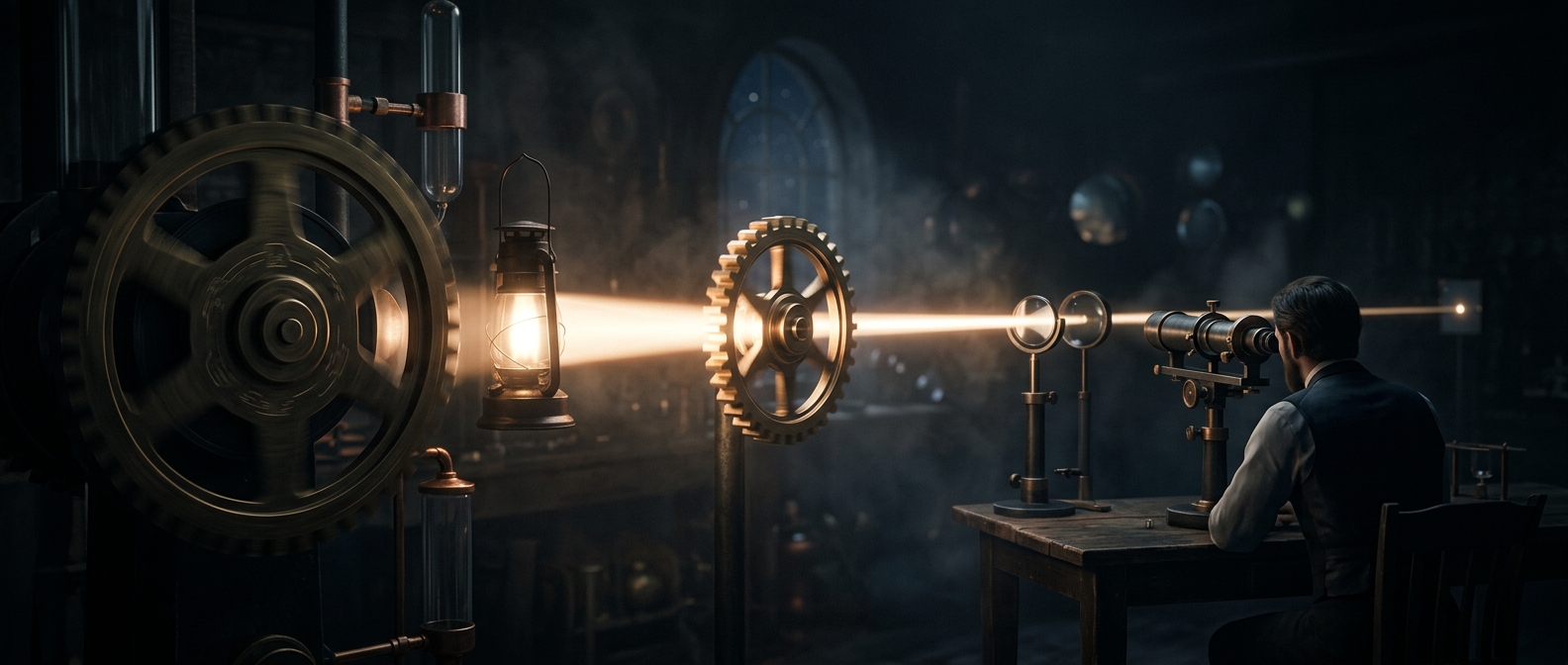
The toothed wheel acted as a repeating shutter: its gaps let light pass, while its teeth blocked it. As the wheel spun faster, the returning beam arrived later in the wheel’s cycle. At a particular speed, a gap that had admitted the outgoing light had rotated into the position of a tooth by the time the light came back. The beam disappeared. That change gave Fizeau a way to match the light’s travel time to the wheel’s rotation.
Why the distance mattered
The reflector sent the beam back along the route, so the light covered the path twice: once outward and once on its return. Fizeau could determine that total distance and calculate how long the wheel took to turn from an open position to a blocking one. Dividing distance by time gave the light’s speed.
This was not a stopwatch catching each pulse. The method inferred an extremely short interval from a slower, observable rotation. Repeating the measurement at different wheel speeds let the disappearance be checked against the wheel’s known pattern of teeth and gaps.
The important shift was that light’s speed could be measured on Earth by arranging a distance and a mechanical timing device. A spinning wheel turned an otherwise imperceptible delay into a simple outcome: the returning spot of light either appeared—or a tooth had moved into its way.