How a bridge cable is built across open air
A suspension bridge’s main cable has to cross a gap that may be too wide for a finished cable to be transported or lifted into place. Instead, builders create it where it will hang. Temporary guide lines are carried from one anchorage—the massive structure that holds each end of the cable—to the other, passing over the bridge towers.
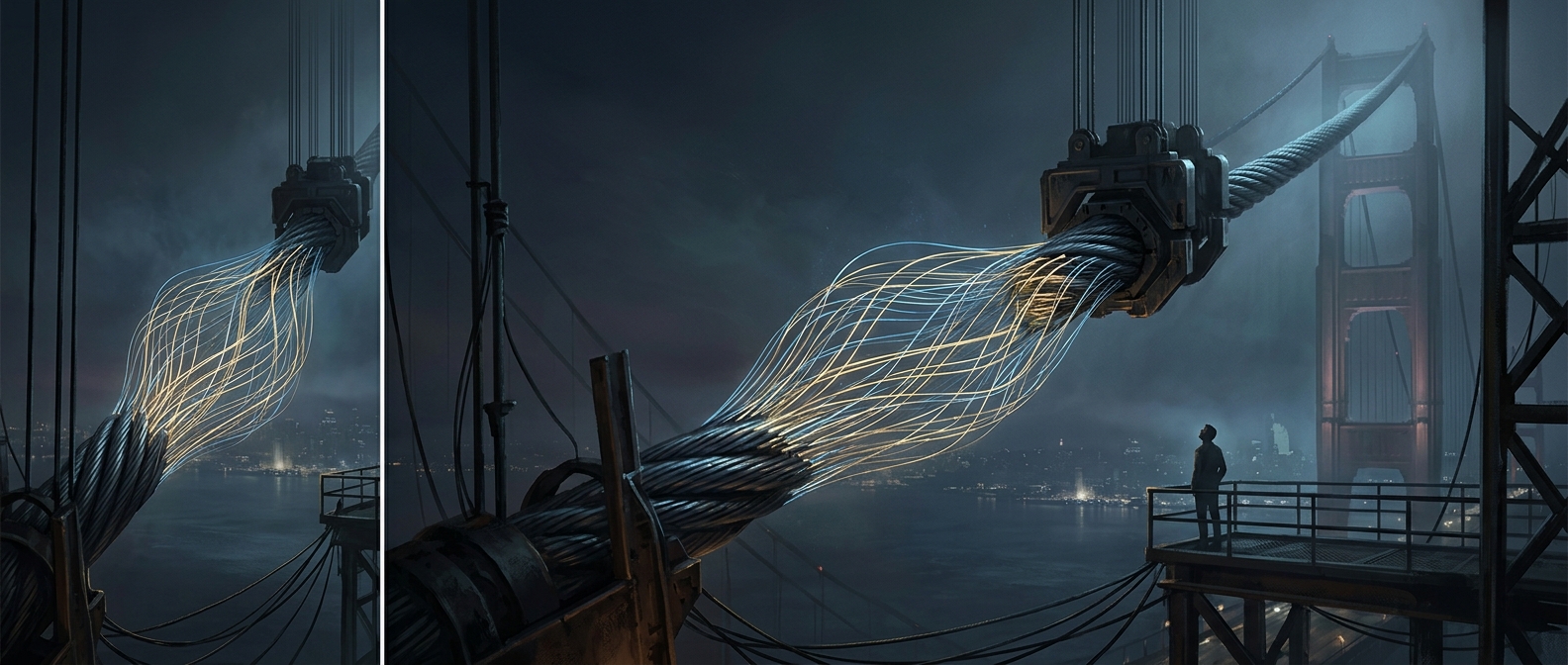
A spinning machine uses those lines to carry high-strength wire back and forth across the gap. Each trip lays another length into the growing cable. The wires are arranged into bundles, then the bundles are gathered and shaped into a compact, round cable. This turns a difficult lift into a controlled sequence of repeated passes.
Why so many wires work together
The cable’s job is to carry the bridge deck’s weight in tension: the pulling force that tries to stretch the cable rather than crush it. Each wire contributes a share of that force. A large number of wires also makes it possible to build the cable to the required size without handling one enormous piece at once.
The main cable rests on saddles at the tops of the towers and is secured at both ends in the anchorages. Smaller vertical suspenders connect it to the deck. In this arrangement, the deck’s load travels through the suspenders into the main cable, then through the towers and anchorages into the ground. The towers support the cable along its span; the anchorages resist its powerful outward pull.
From loose bundle to working structure
Once the wires are gathered, crews compact and bind them so the cable holds its shape. A protective outer wrapping helps shield the steel from moisture, which can lead to corrosion. The result looks like a single solid rope, but its strength comes from many separate wires acting together.
That assembly method has a striking consequence: a bridge cable can be made to match the span without ever being lifted as one piece. The crossing itself becomes the construction site.