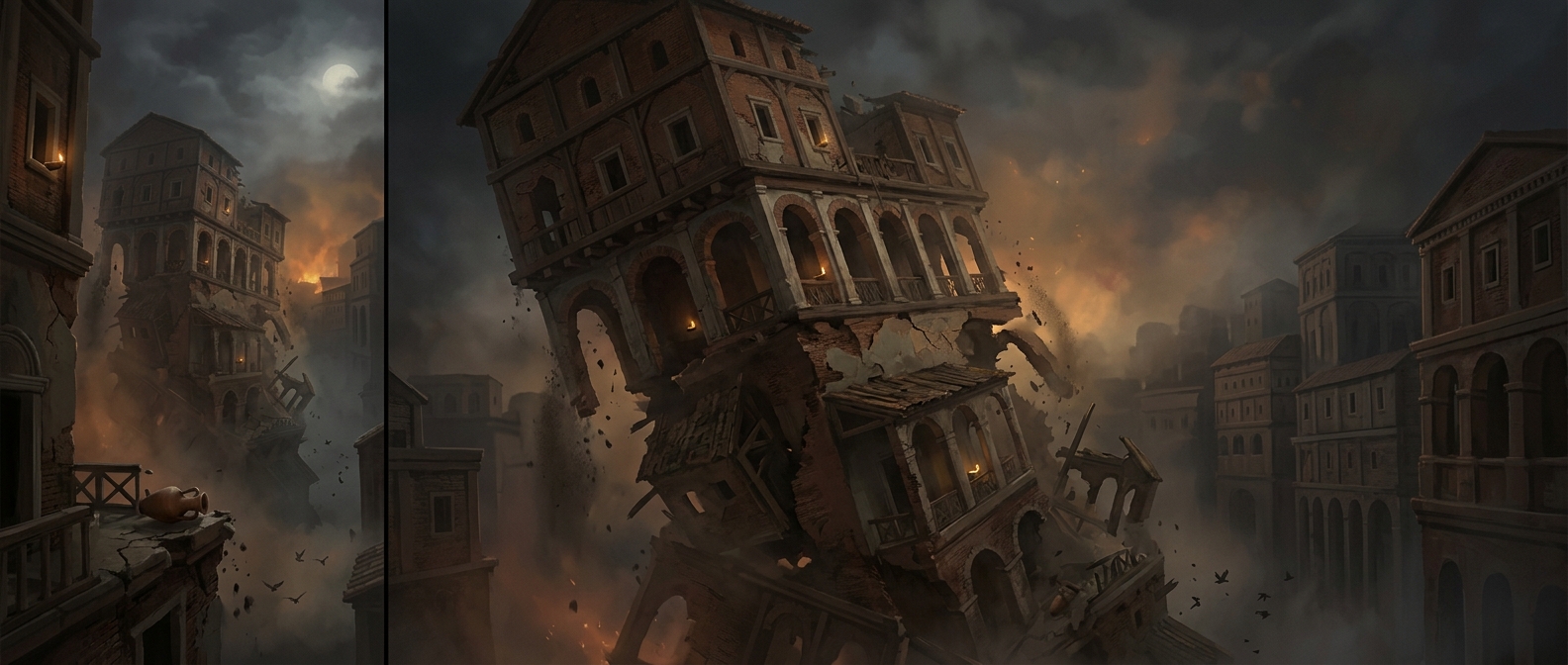
Building upward on a weak foundation
Rome’s insulae—the Latin word for “islands,” also used for apartment blocks—packed many households onto valuable urban plots. To fit more rentable rooms into a small footprint, builders stacked floors above shops and workshops. But height increased the load on the walls and supports below, while hurried construction and inexpensive materials could leave little margin for error.
Timber beams and mudbrick were practical and widely available, but they demanded careful design and upkeep. Mudbrick could weaken when exposed to water; timber could decay or burn. If a lower wall or beam failed, the weight above it could turn a local defect into a collapse across several floors.
The landlord’s return, the tenant’s exposure
The financial incentives were uneven. A landlord could earn rent from each additional floor, while the cost of stronger construction cut into the building’s return. Tenants, especially those with limited means, had little say in how their rooms had been built or maintained. They paid for shelter but could not inspect the hidden supports holding it up.
That did not make every insula a deathtrap: buildings differed in quality, and construction materials alone do not explain every failure. But in a crowded city where demand for housing was high, weak design and neglected repairs could combine with the pressure of extra stories. The danger was built into the structure—and borne most directly by the people living inside it.