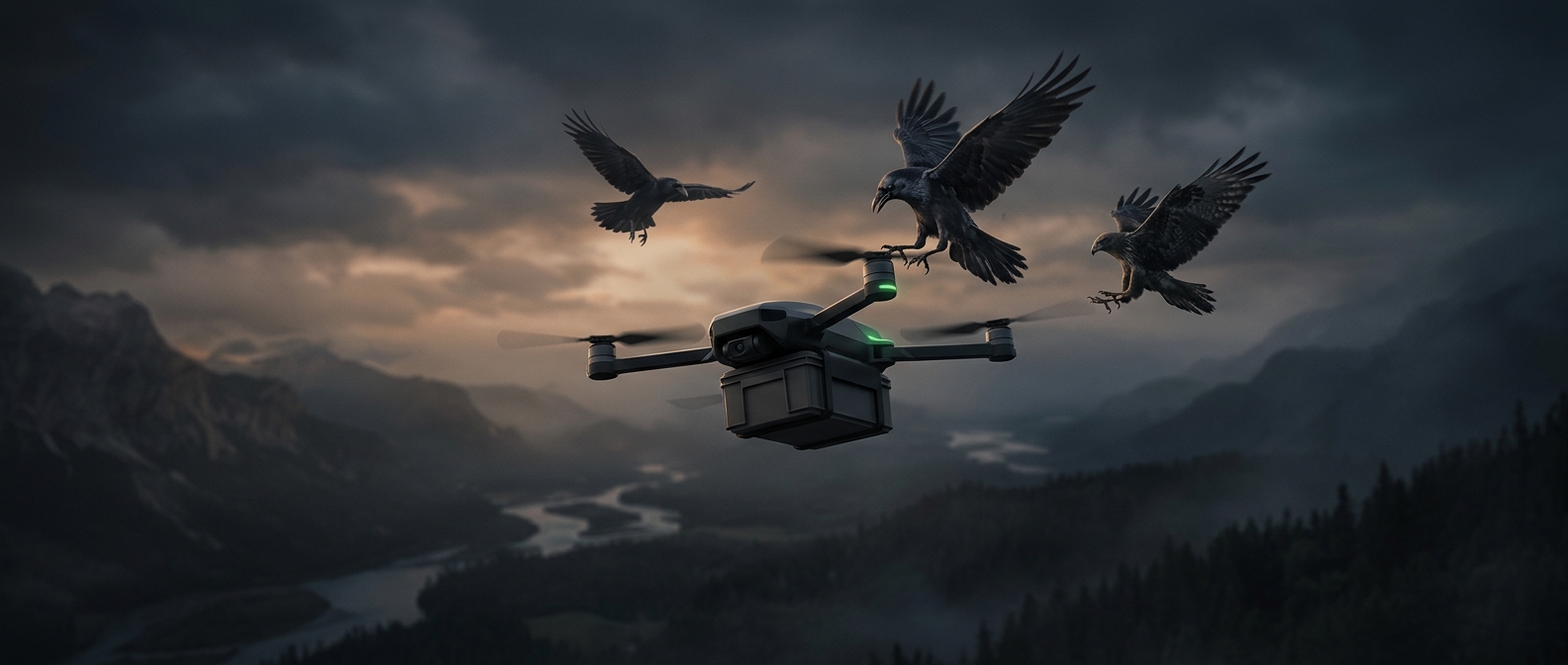
Why a Delivery Drone Can Become a Target
A bird defending a nest is responding to a nearby disturbance, not to the drone’s purpose. During breeding season, some birds treat an unfamiliar object approaching their nesting area as a potential threat and try to drive it away. A drone’s steady position can make that response easier to sustain: unlike a passing vehicle, it may remain in the bird’s airspace while completing a delivery.
The Conflict Between Hovering and Defending
Hovering is useful for a drone that needs to lower or release a package at a precise spot. It also keeps the aircraft in one place long enough for a defensive bird to make repeated approaches. The encounter can put the bird at risk of hitting the aircraft, while a collision or abrupt evasive move can endanger the drone and whatever it is carrying.
The challenge is therefore not simply making a drone sturdy. A stronger aircraft might better withstand contact, but it would not remove the disturbance or the risk to wildlife. Nor can every encounter be solved by flying faster: a route that avoids one nest could bring the drone closer to another.
Wildlife Becomes a Route-Planning Constraint
Operators can treat repeated bird approaches as a reason to change how or where a delivery is made—for example, by avoiding a sensitive area or stopping a flight when a bird is actively defending it. That creates a practical tradeoff: a route that is efficient on a map may be unsuitable at a particular place or time.
For delivery networks, the lesson is that the final stretch of a flight is not empty air. A nest can turn a routine hover into a safety problem, making local wildlife behavior part of the operating conditions a drone must accommodate.