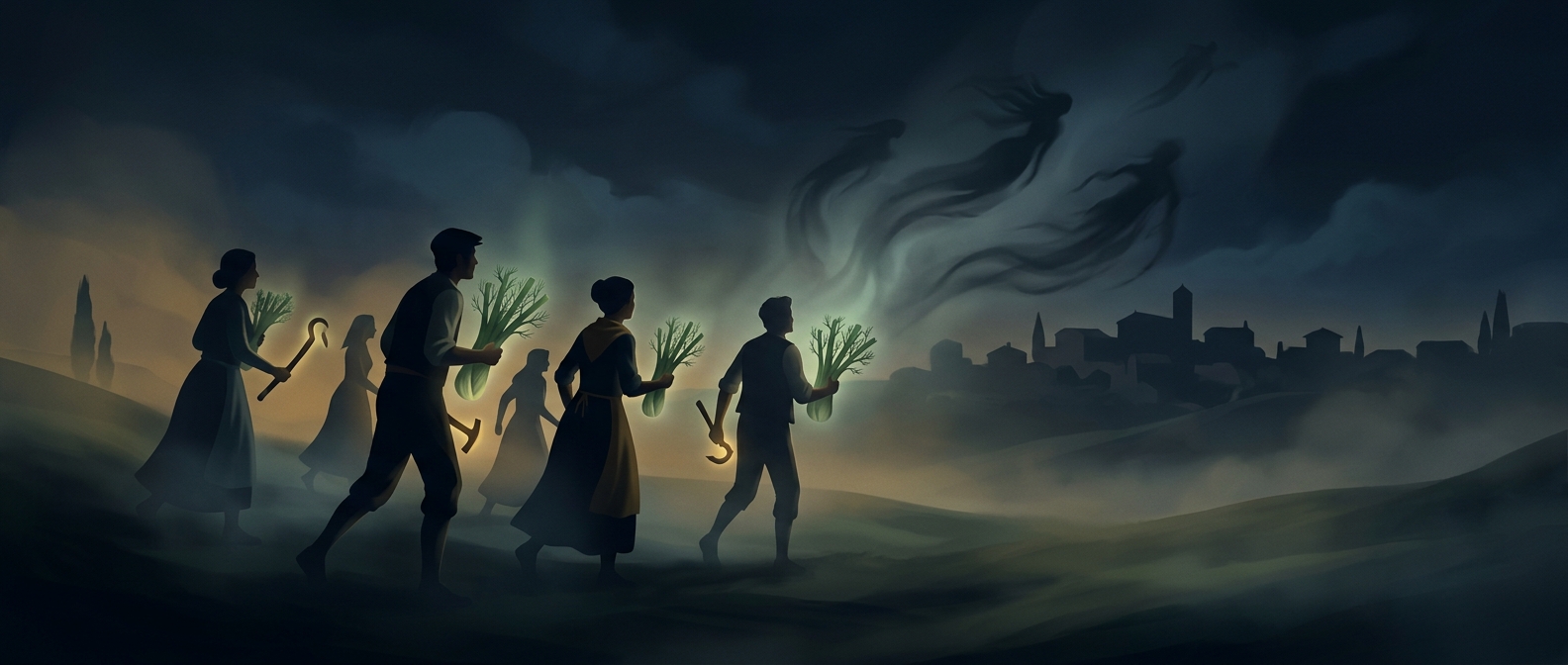
A spiritual battle over the harvest
In the farming communities of Friuli, in northeastern Italy, the Benandanti—literally, “good walkers”—understood certain nighttime journeys as a defense of the fields. They believed their souls left their sleeping bodies to confront witches. Fennel stalks served as weapons in the struggle, while the opposing side was associated with sorghum stalks. The outcome mattered because it was thought to determine whether the crops would prosper or fail.
That made the encounters more than strange tales about nocturnal combat. They gave a human shape to the uncertainty built into farming: a harvest depended on forces villagers could not fully control, from weather to pests and disease. In the Benandanti’s account, the danger to the crop had an adversary—and the community had defenders.
When local belief met the Inquisition
The Benandanti came to wider attention through inquisitorial records from the late sixteenth century onward. Church investigators questioned them about their nighttime journeys, placing those claims within the language of witchcraft and religious wrongdoing. The records therefore preserve both the Benandanti’s descriptions and the pressure of an institution trying to classify beliefs that did not fit neatly into its categories.
The contrast at the heart of the story is striking: a battle said to decide the fate of a harvest was fought with stalks from the fields themselves. The crops were not merely the prize; they supplied the imagined weapons in a conflict over who would protect them.