A landscape shaped into a hunting tool
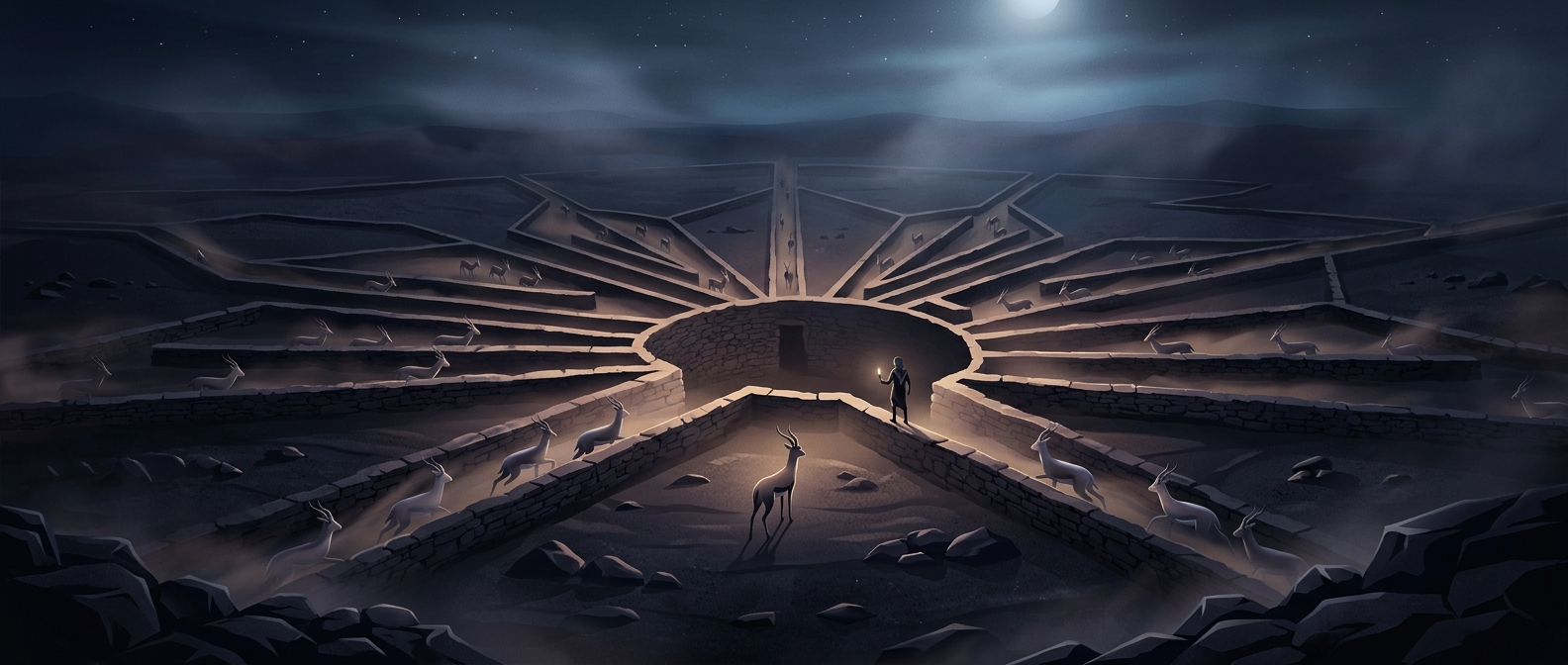
The walls work by steering movement, not by forming a solid barrier. Their long arms spread across open ground and gradually narrow, turning a broad stretch of desert into a funnel. A herd moving through the landscape could be guided toward the trap’s enclosed end, where deep pits made escape difficult. The design used distance and terrain to do much of the work that a close-range hunt would otherwise require.
Why the pattern is clearer from above
At ground level, low stone lines can look like disconnected rubble. From the air, their scale and geometry become legible: walls extend for long distances, converge, and end at a confined area. That view reveals that the stones were not simply a boundary around a field or settlement. They formed a coordinated structure intended to channel animals.
A record of organized effort
Building and maintaining such extensive walls required people to work across a large area and to understand how animals moved through it. The traps therefore preserve evidence not only of hunting, but of planning: the builders shaped the landscape so that a herd’s movement could become predictable. In Jordan’s open desert, the most important part of the structure is easy to miss on foot—the long, subtle lines that turn empty-looking ground into a route toward the pits.