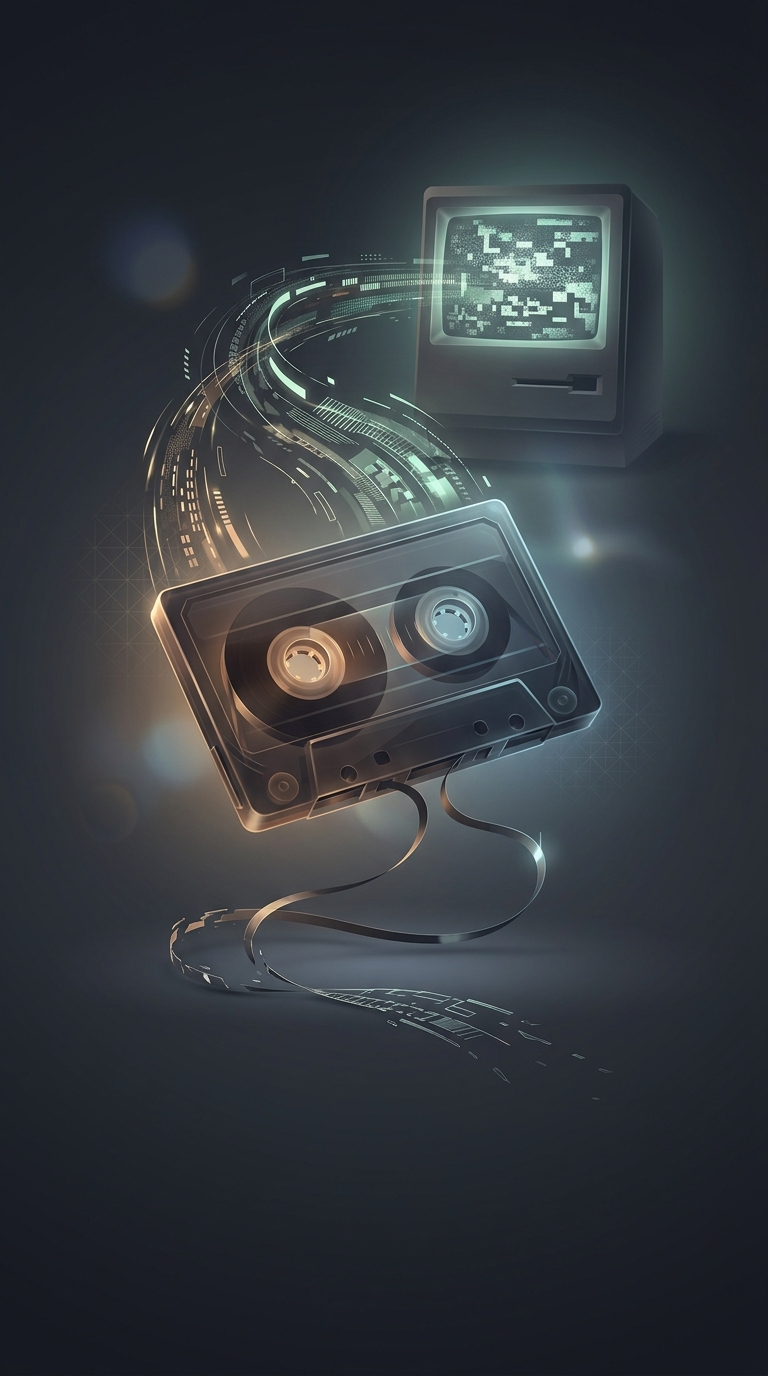
How a cassette became computer storage
Many early home computers had no disk drive, so a cassette recorder offered a cheap way to save and load programs. The computer translated digital data into patterns of sound—changes in tone and timing—which the recorder captured on ordinary magnetic tape. During loading, the computer listened through an audio connection and decoded those patterns back into instructions.
That piercing squeal was not background noise: it was the program being read aloud, in a form a person could hear but could not understand.
Why loading took so long
A cassette plays in sequence. Unlike a disk drive that can jump to a particular spot, it must pass the recorded data under the tape head in order. The computer also had to receive enough of the recording to reconstruct the program, so a large game could keep the machine occupied for many minutes. Exact loading times varied with the computer, tape, and program; a wait approaching 20 minutes was possible, not universal.
The process was also sensitive to the quality of the signal. The recorder’s volume and playback speed had to be suitable for the computer to distinguish the encoded tones. If the tape was worn, stretched, or poorly recorded, the sound could become difficult to decode. A bump or loose connection could interrupt playback and leave the computer with incomplete data.
A fragile kind of “booting”
Loading a game was therefore less like opening an app and more like receiving a long, uninterrupted transmission. Players often had to rewind the tape, find the right starting point, connect the recorder, and wait—without disturbing the setup. If the computer failed to recognize the data near the end, the practical remedy could be to start over.
That constraint shaped the experience of home computing: before play began, the machine and its owner had to get through a noisy, delicate transfer one strip of tape at a time.