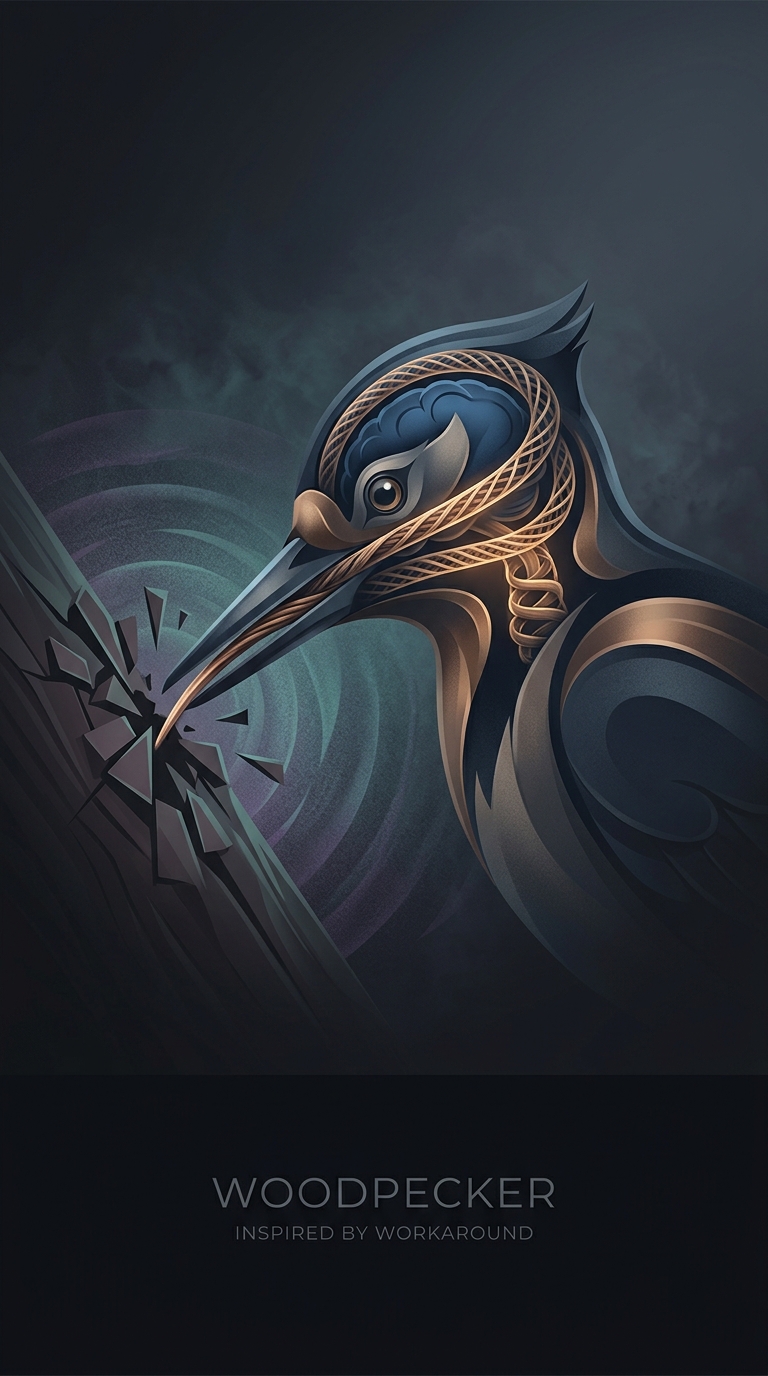
A woodpecker’s tongue takes a detour around its skull
In many woodpeckers, the tongue is attached far back in the mouth and supported by a long, flexible structure of cartilage and bone called the hyoid apparatus. As this support extends, it curves around the back of the skull and over the top, then reaches forward toward the beak. The arrangement lets the bird extend its tongue well beyond its bill to probe crevices and pull out insects.
The route varies among species, but it is a real anatomical feature—not a tongue wrapped tightly around the brain. Its main job is helping the bird feed, not cushioning its head during pecking.
Why pecking does not simply scramble the brain
A woodpecker’s head does experience repeated impacts, but the bird does not strike a tree at twenty blows per second as a universal rule, and the impacts do not mean its brain is being liquefied. Pecking rates and force vary with the bird’s size and what it is doing. When excavating a nest cavity, a bird may deliver many blows; when searching for food, it often taps differently.
Resistance to impact is better understood as a combination of factors. The bird’s compact head and relatively small brain reduce movement within the skull, while the beak, skull, neck, and body help manage the forces involved. The bird also braces itself against the tree with its feet and stiff tail, and its pecking motion is controlled rather than a sequence of uncontrolled collisions. No single feature—including the tongue—accounts for the whole effect.
One structure, two separate stories
The tongue’s looping support is striking because it occupies so much of the head’s anatomy, and its path differs across woodpecker species. But the familiar image of it acting as a built-in helmet turns a feeding adaptation into a tidy explanation for a much more complex problem. The tongue helps the bird reach food; the bird’s impact tolerance depends on the head and pecking working together.