Why an owl’s eyes do not follow its gaze
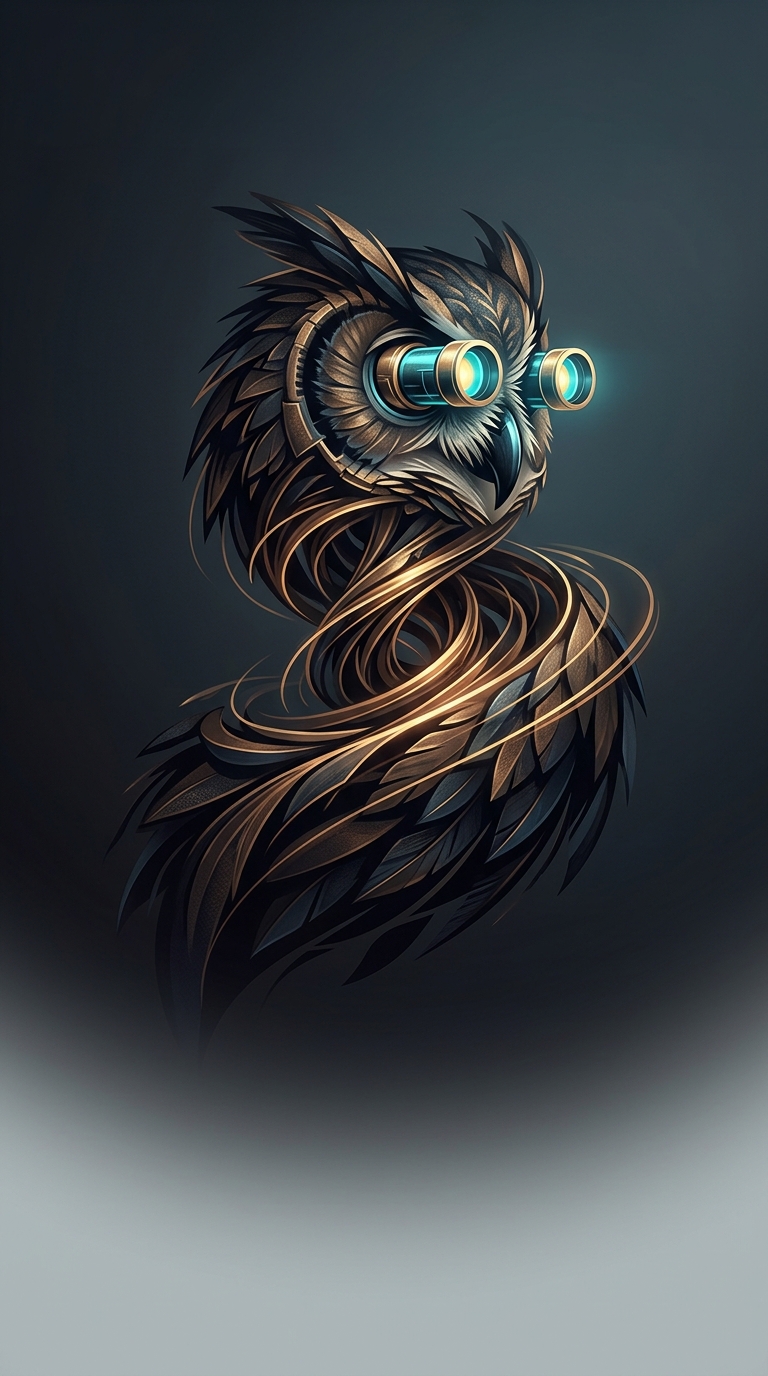
An owl’s eyes are built for gathering light and judging distance, not for swiveling in their sockets. Their shape and position give them a broad overlap in what both eyes see at once—a useful arrangement for estimating how far away prey is. But because the eyes barely move, the bird cannot simply glance sideways the way a person can. To aim its vision elsewhere, it turns its head.
That tradeoff makes the owl’s neck part of its visual system. A turn redirects both eyes together, keeping their shared view pointed at a target while the rest of the body can remain still. This lets an owl watch a sound or movement without immediately shifting its whole body, which could alert prey.
How the neck makes a large turn possible
The familiar “270 degrees” describes the total arc of a turn, not a full rotation in one direction. An owl can turn roughly 135 degrees to either side from a forward-facing position. Its neck vertebrae and the routes taken by blood vessels accommodate that motion: the vessels have room to shift and stretch, and the vertebrae provide space around them as the head turns.
Those adaptations matter because the brain still needs a steady blood supply while the neck is twisted. In many animals, a sharp turn could compress or overstretch vessels. In owls, the neck’s structure helps preserve circulation through the movement.
A different way to scan the world
The result is a striking division of labor: fixed eyes provide a stable, forward-focused view, while a highly mobile neck repositions that view. When an owl appears to stare without blinking at something off to the side, it is not moving its eyes toward the target. It is bringing its entire face around to meet it.