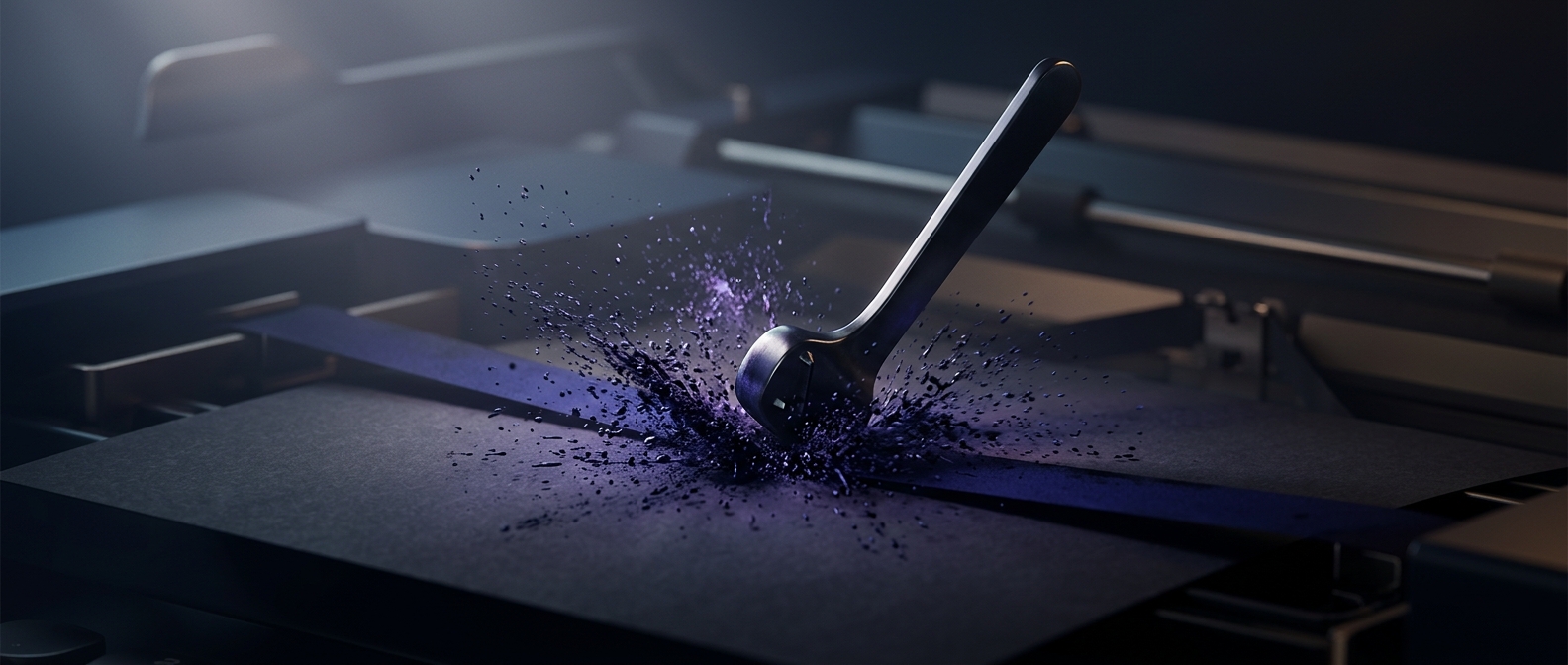
How a tiny ball turns ink into a line
At the tip of a ballpoint pen, a hard metal sphere sits in a closely fitted socket. The fit is precise but not airtight: a narrow passage lets ink from the cartridge reach the back of the ball while keeping the reservoir from simply draining onto the page.
As you push the pen across paper, friction makes the sphere rotate inside its socket. The portion that was touching the ink turns outward, carrying a thin coating to the paper; another part of the sphere turns inward to pick up more. The ball therefore acts as both a moving ink carrier and a small valve.
A narrow gap does a lot of work
The ink must be fluid enough to travel through the tip, yet thick enough not to pour out when the pen is idle. Its flow also depends on the tiny spaces around the ball and on the pressure of writing. Too little flow produces a faint or broken line; too much leaves blobs and smears.
The ball and socket help manage that tradeoff. The ball’s close fit limits leakage, while its rolling motion renews the ink at the writing surface. Because the ink is exposed to air mainly at the small opening, the tip also helps limit drying between uses.
That simple motion is why a ballpoint can keep a reservoir of liquid ink under control: each turn of the ball carries only a small film to the page, rather than releasing the ink all at once.