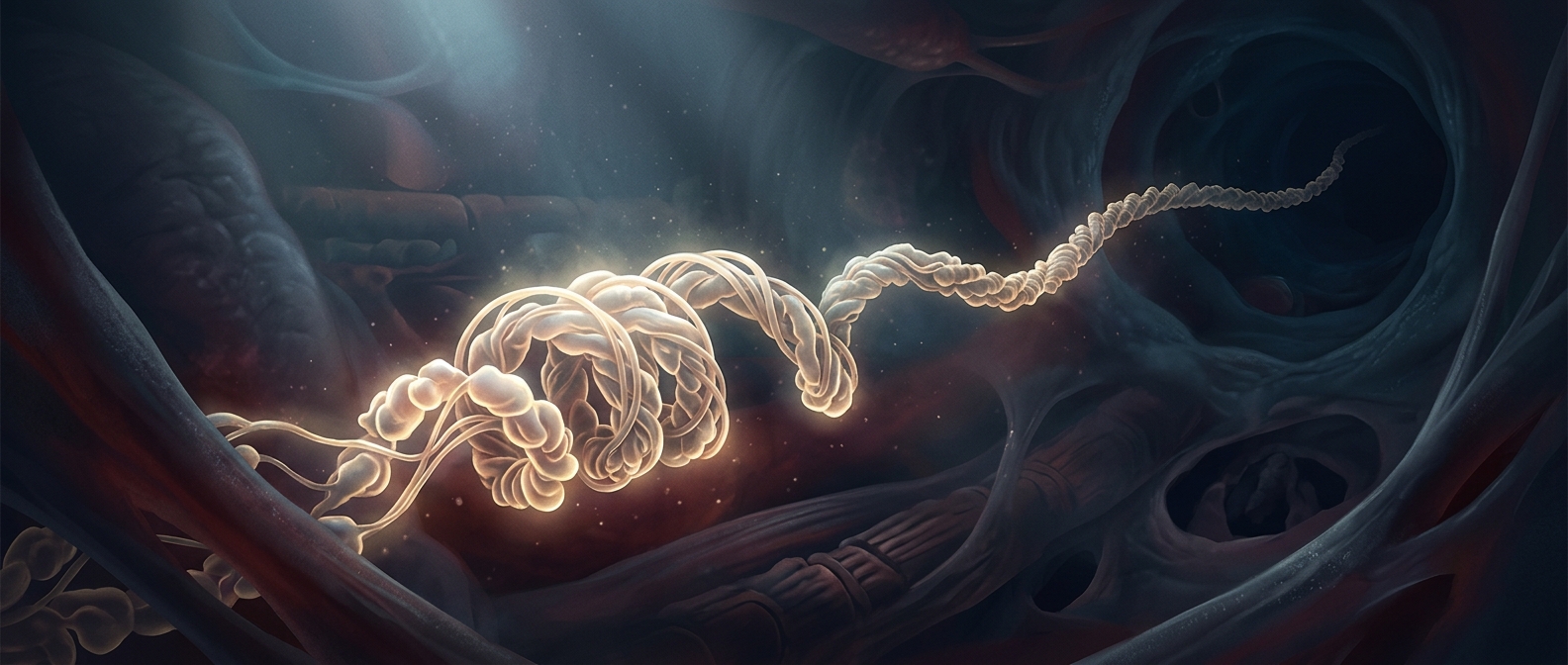
A protein that yields in stages
Inside each muscle fiber, the giant protein titin runs through the repeating units that contain the muscle’s contractile machinery. It helps keep those units aligned and also behaves like an elastic tether when the muscle is stretched. Some sections of titin are folded into compact domains—small, tightly organized parts of the protein.
As tension rises, a folded domain can open, or unfold, taking up some of the stretch. Because these domains give way successively rather than all at once, titin’s length can increase in stages. That changes how force is transmitted: some of the energy of a pull is absorbed in rearranging the protein instead of being passed directly through the muscle’s internal structure.
Yielding without breaking
Unfolding is not the same as tearing. A domain opens under force, and when the load falls, it can fold again. This makes titin more than a simple rubber band: it can both resist stretch and soften the sharpest changes in tension. The response depends on how much force the muscle experiences and how quickly it is stretched, so the protein’s behavior is dynamic rather than a fixed spring constant.
That staged give helps muscles cope with changing loads during movement. Titin contributes to the muscle’s passive resistance—the tension present even when its contractile machinery is not actively shortening—and helps limit abrupt force spikes. At the molecular scale, a stretch is therefore not one sudden tug on one rigid structure; it is distributed across many protein domains that can open, absorb energy, and later recover.