How a woodland browser became built for open ground
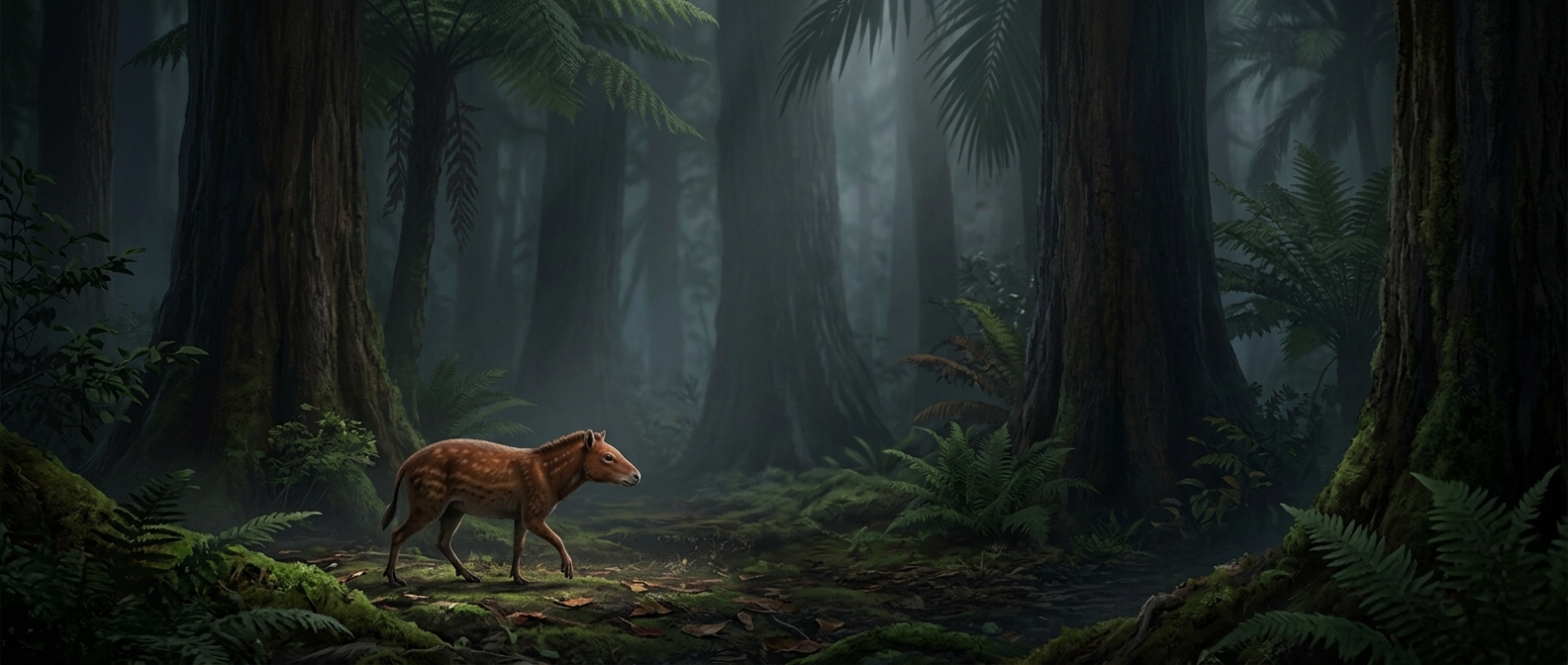
The fox-sized early horse usually pictured in this story is often called Eohippus. It was an early member of the horse family, not necessarily the direct ancestor of every later horse: evolution is a branching family tree, and many equid species lived and disappeared along the way.
Its small body and several toes suited movement through soft, tangled woodland. Over millions of years, environments in parts of the world shifted, with more open habitats and grasses becoming increasingly important. Horse relatives adapted to those changing conditions in different ways.
Legs and teeth changed together
On firmer, more open ground, longer limbs could help an animal cover distance and escape danger. In horse lineages, the central toe grew more prominent while the side toes diminished, eventually leaving modern horses with a single weight-bearing hoof. This was a gradual change across generations, not a transformation any individual animal could make during its life.
The food shift also left clues in the skull. Leaves are relatively soft; grasses are tougher and often carry gritty particles that wear teeth down. Later horse relatives developed taller-crowned cheek teeth, giving them more tooth material to withstand that abrasion. Their teeth could keep working as the chewing surfaces wore away.
These changes did not follow a simple march toward a “better” animal. Different horse relatives suited different settings, and the familiar modern horse is just one surviving branch. The striking result is that a tiny, many-toed browser belongs to the same broad family as an animal whose hoof and durable teeth are suited to traveling and feeding in open country.