How Venus’s mountains imprint the clouds
Venus’s atmosphere is thick enough that moving air behaves less like a faint breeze and more like a flowing fluid. When winds encounter high ground, they are forced upward. After passing over the terrain, the displaced air does not simply settle at once: gravity pulls it back down, while the air’s resistance to being compressed and buoyancy push it upward again. This back-and-forth motion creates an atmospheric gravity wave—a pattern of rising and sinking air, not a wave traveling across the ground.
The wave can extend far beyond the mountain that started it. As it moves upward through the atmosphere, it changes the pressure, temperature, and density of the air. Those changes affect clouds, making the otherwise invisible motion show up as bands or ripples in cloud brightness and structure.
A pattern that stays while clouds flow
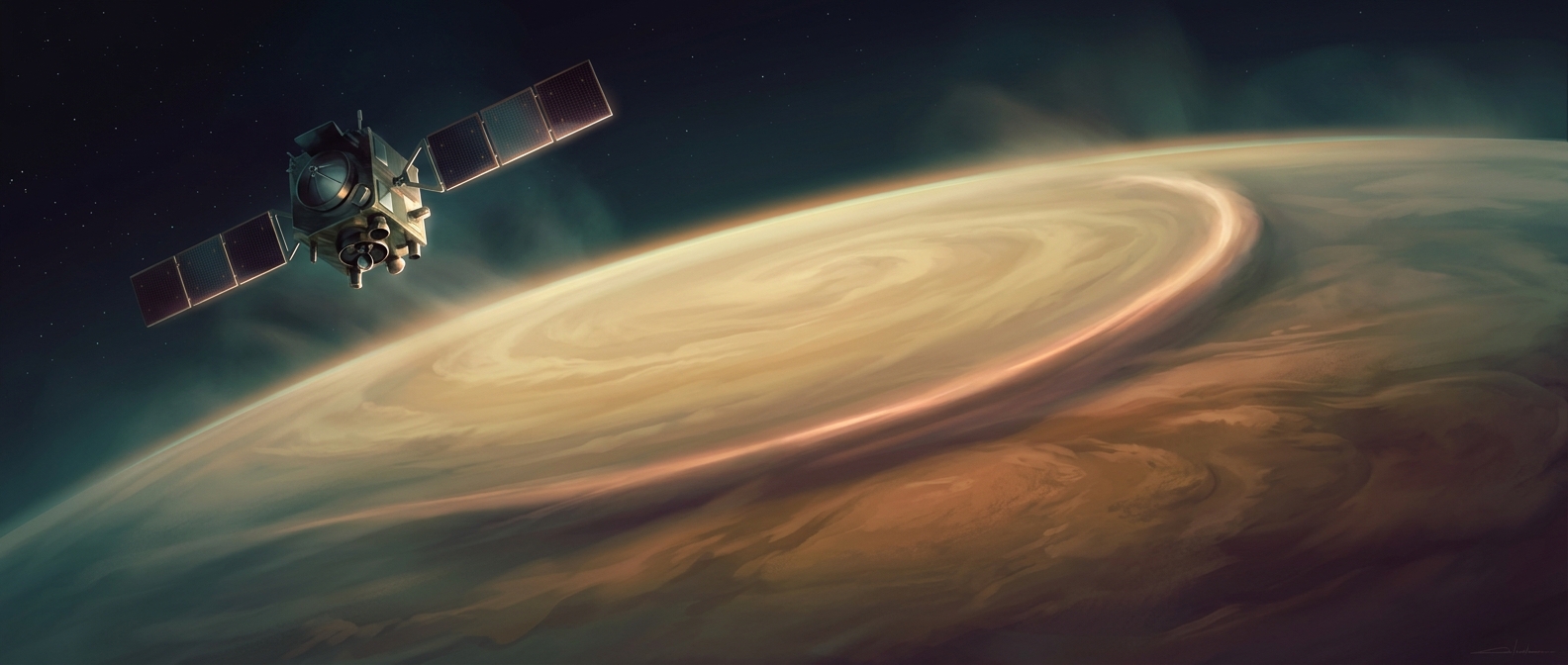
Venus’s upper clouds race around the planet, but a terrain-generated wave can remain anchored above the highlands that produce it. Cloud material streams through the pattern, just as water passes through a standing wave in a river. That distinction matters: the long feature seen in the clouds is not a single cloud stretched across the planet, but a moving atmosphere continually reshaped by the same underlying terrain.
The result gives scientists a way to connect what is visible high above Venus with the planet’s hidden surface. A ripple in the clouds can reveal where air is being lifted by mountains below—and show that landforms can influence atmospheric patterns on a scale thousands of kilometers wide.