Why a pendulum’s swing seems to turn
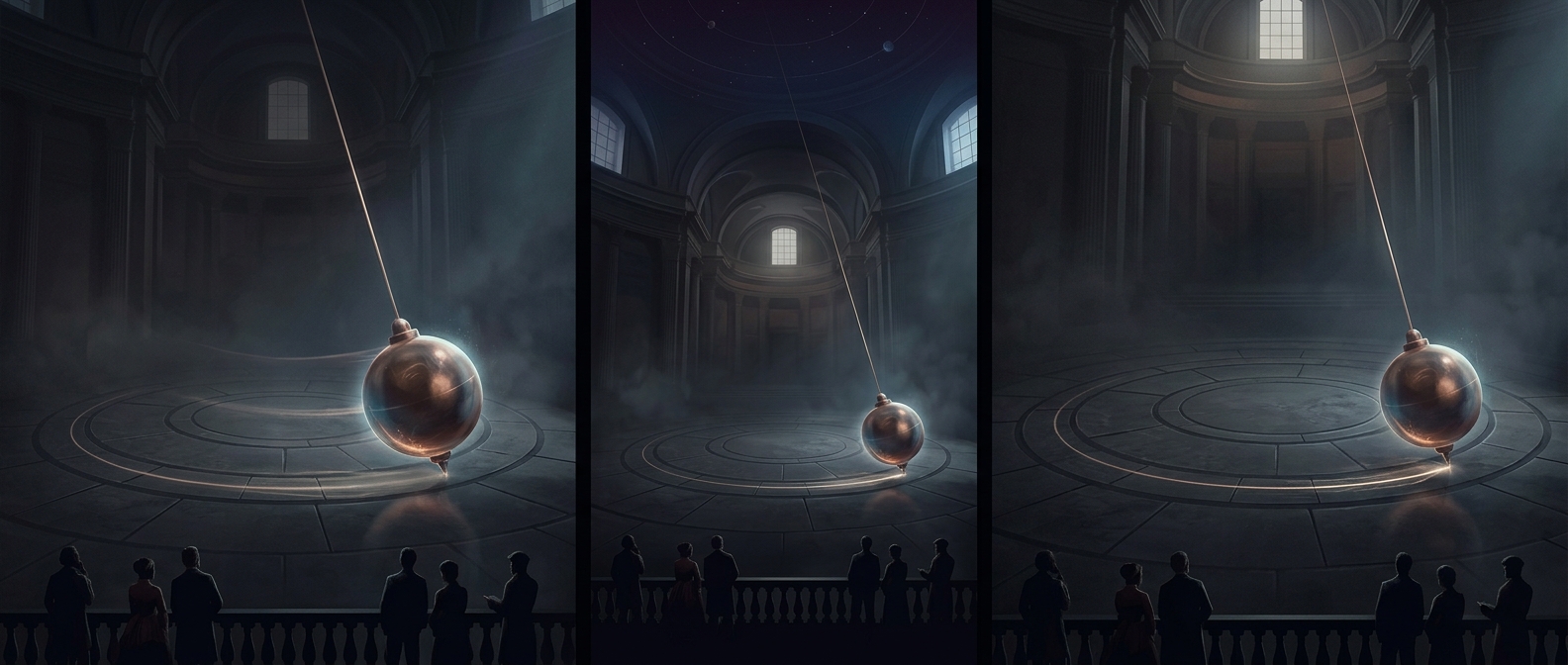
A freely swinging pendulum tends to keep oscillating in the same vertical plane because its motion carries momentum: absent a sideways force, that plane does not rapidly twist to follow the room. But the room is attached to Earth, which rotates beneath it. To someone standing on the floor, the pendulum’s direction of swing therefore appears to shift over time.
The effect is not a motor in the pendulum or a gradual change in its aim. It is a difference between two frames of reference: the swing’s nearly fixed orientation and the rotating ground used to judge it. In the rotating frame of Earth, the same effect can be described through the Coriolis effect, an apparent sideways deflection of moving objects.
Why latitude changes the pace
Earth’s rotation produces the clearest change in the swing’s orientation at the poles, where the ground turns beneath the pendulum without carrying it around a broad circle of latitude. There, the swing’s plane appears to complete a turn in about a day. At the equator, Earth’s rotation does not produce this turning of the plane, so the effect vanishes. Between those extremes, the rate depends on latitude.
A long pendulum makes the change easier to see because its swing can be tracked over a wide area and for a long time. The demonstration turns an otherwise invisible planetary motion into a slow shift against familiar landmarks: the floor appears to rotate, while the pendulum’s swing provides the steadier reference.