The Sun’s last eight minutes
Light travels through space at about 300,000 kilometers per second. From the Sun’s visible surface to Earth, the trip takes roughly eight minutes and 20 seconds. So when sunlight reaches your eyes, it shows the Sun as it was a little over eight minutes earlier.
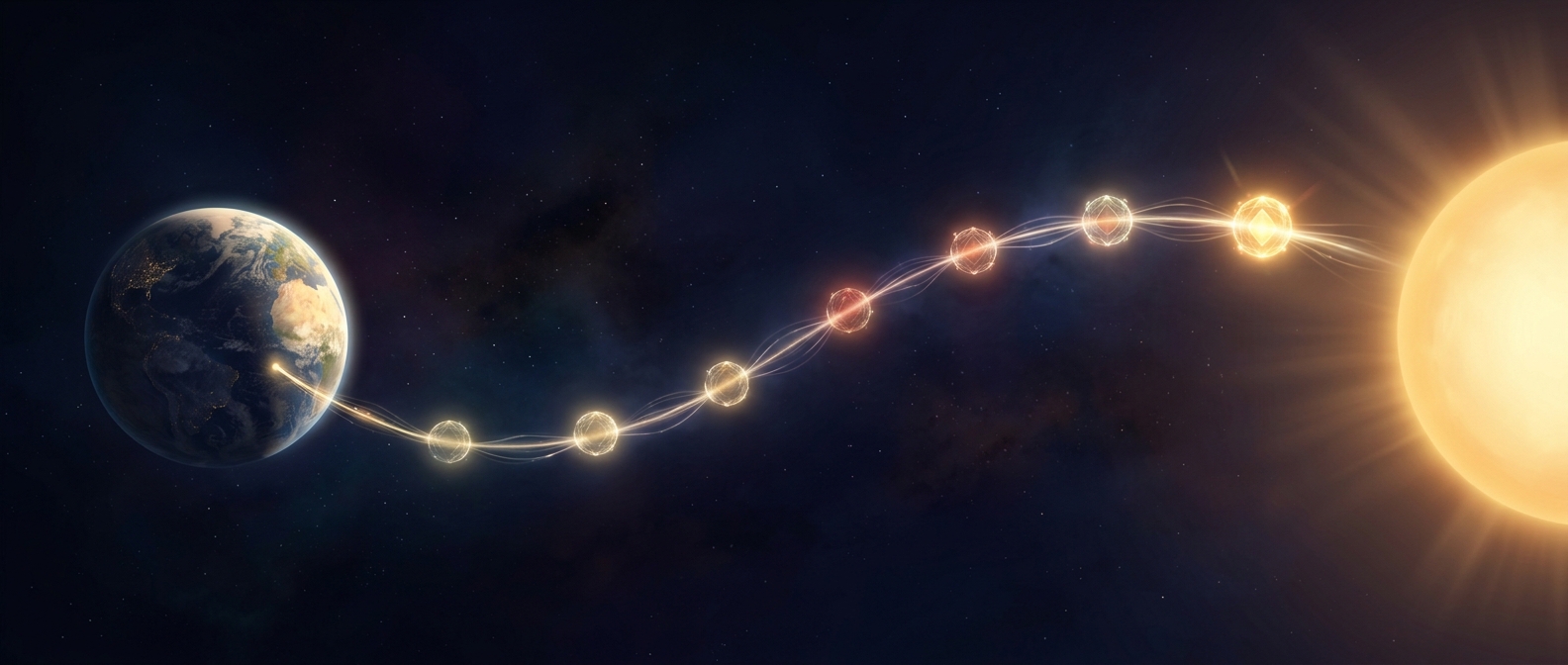
But the energy in that light began its journey much farther inside the Sun. In the core, nuclear fusion releases energy. The route from there to the surface is not a clear passage: the Sun is dense, and energy repeatedly collides with particles, gets absorbed, and is passed along again.
A journey by many handoffs
This process is sometimes described as a random walk. Rather than moving straight outward, energy changes direction over and over as it interacts with matter. In the Sun’s outer layers, large-scale movement of hot gas also helps carry energy toward the surface.
That means it is misleading to picture one light particle traveling all the way from the core and then crossing space to Earth. The original energy is transformed and handed along many times. The sunlight that finally escapes is emitted near the surface, where it can stream through space largely uninterrupted.
The clock starts at the surface
Once light leaves the Sun’s visible surface, the remaining distance is comparatively simple: a nearly straight journey across space. That is the leg measured by the familiar eight-minute figure—not the time since the energy was produced in the core.
The next time sunlight warms your face, its brief trip through space is only the final chapter. Its energy has already made a far longer, indirect passage through the Sun.