How Prometheus Ruffles Saturn’s F Ring
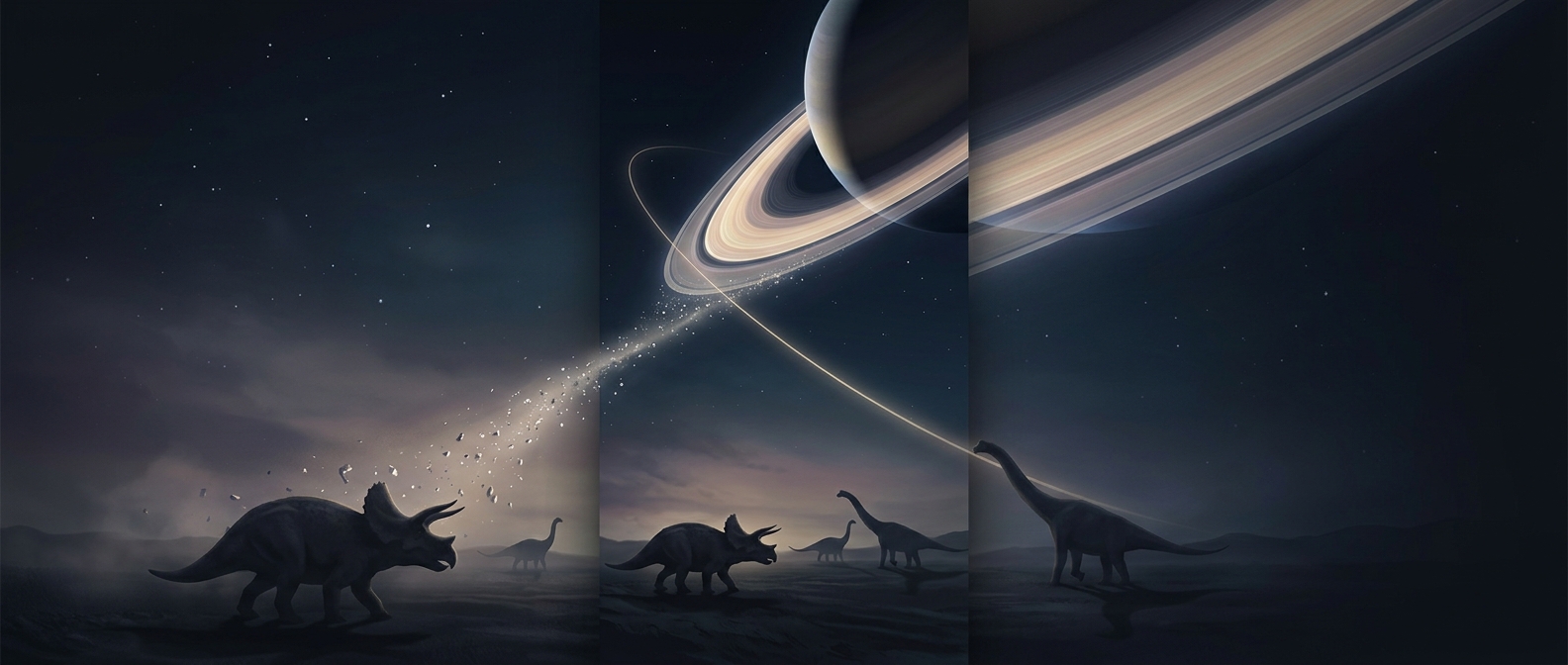
Prometheus does not sweep Saturn’s F ring into a neat circle. It repeatedly perturbs the ring, pulling some icy material into narrow streamers and leaving gaps or kinks behind. The moon’s orbit takes about 14.7 hours, so it returns to the same busy neighborhood on a rapid cycle.
Prometheus travels just inside the F ring. Its gravity reaches beyond its own path, tugging on particles as it passes. Because nearby particles are moving at slightly different speeds around Saturn, a brief pull can stretch into a long, thin feature: material drawn outward may lag or race ahead, producing the tangled strands that make the ring look disturbed.
A Ring Shaped by Repeated Encounters
The F ring is narrow but not rigid. It is made of countless particles orbiting independently, not a solid band that can simply be pushed back into place. Prometheus’s repeated encounters help create its changing structure; they do not restore every displaced particle to a flawless circle. Other gravitational influences, including the nearby moon Pandora, also help shape the ring, while collisions among particles can further alter its appearance.
That combination makes the F ring a visible record of ongoing orbital interactions. A moon can be small compared with Saturn and still leave a striking mark—not by bulldozing the ring, but by nudging particles onto slightly different paths that spread into streamers over time.