Why an Elephant Skull Can Look One-Eyed
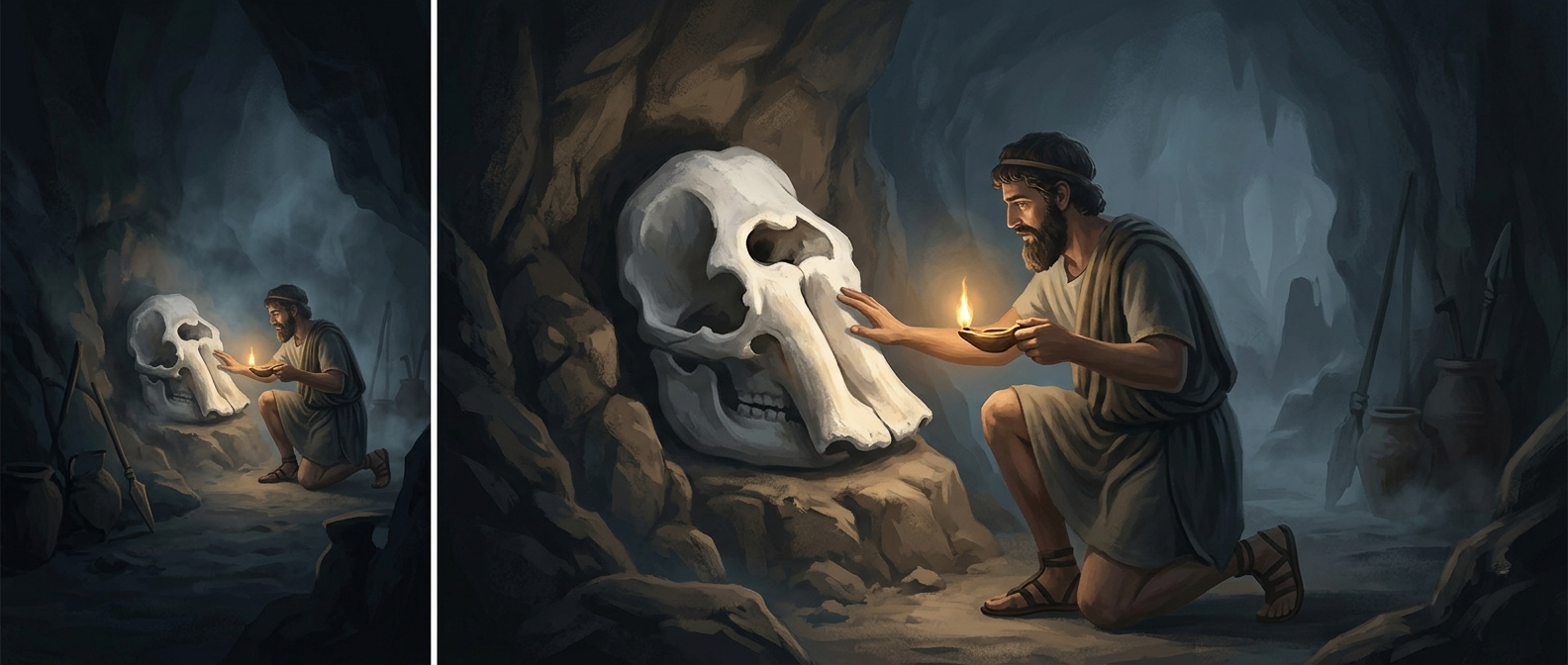
A skull is easy to misread when its soft parts are gone. In a dwarf elephant, the large opening at the front of the skull carried the trunk’s nerves and blood vessels. Seen without the trunk—and without knowledge of elephant anatomy—that opening can resemble a single enormous eye socket. The actual eye sockets sit farther to the sides and may be less obvious in a damaged or weathered skull.
This resemblance offers a possible clue to the Cyclopes, the one-eyed giants of Greek myth. Dwarf elephants once lived on Mediterranean islands, including Sicily, where ancient people could encounter their bones. A skull found in the ground might have looked like physical evidence of a giant creature with one eye.
A Plausible Clue, Not a Proven Origin
The idea explains how a real object could have reinforced a story: the bones supplied a startling shape, while storytelling supplied the giant. But no surviving account establishes that a particular skull inspired the myth, and a resemblance alone cannot show when or how the story began. The Cyclopes belonged to a wider tradition of tales about extraordinary beings, so fossils may have contributed to the image without being its sole source.
The striking possibility is that a feature built for a trunk could be mistaken for an eye—and that a fossil’s silhouette might help turn an old tale into something people could point to in the landscape.