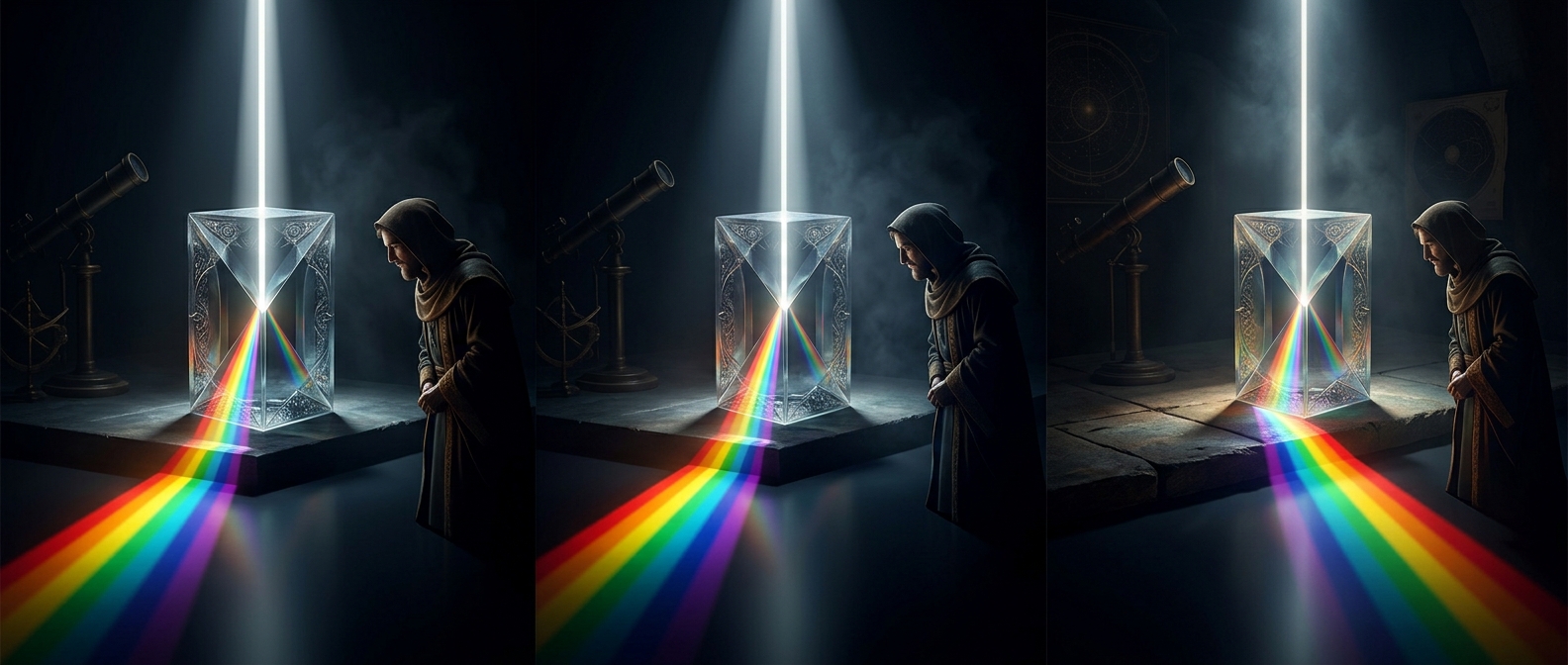
Why a raindrop separates colors
Sunlight looks white because it contains a mixture of visible wavelengths. In a raindrop, those wavelengths do not travel at exactly the same speed: when they cross from air into water, each one changes direction by a slightly different amount. This effect, called dispersion, turns a small difference in wavelength into a spread of directions.
The drop’s shape and the light’s path matter too. A ray refracts as it enters, reflects from the curved back of the drop, then refracts again on its way out. The second bend increases the separation between colors. Each drop sends only a narrow range of angles back toward an observer, so a single drop contributes just one color to that person’s view—not a miniature rainbow.
Why the bands appear in the sky
Your eye sees red where drops in one direction send red light toward you, and violet where drops in a slightly different direction send violet. Drops between those directions supply the colors in between. The familiar bands are therefore not painted onto a distant screen; they are the combined light from many drops arranged along particular lines of sight.
Move to another spot, and the lines of sight change. The drops that send the right colors to you are no longer the same drops that send them to someone standing beside you. That is why a rainbow has no fixed location in the landscape: it is assembled anew for each observer from the geometry between the Sun, the droplets, and the eye.