Why a spinning star sheds matter at its waist
A star’s gravity pulls its gas inward, while rotation makes that gas push outward. The outward effect is strongest at the equator, where material circles fastest. As a star spins more rapidly, gravity has to work harder to keep its equatorial layers bound; near the limit, a small additional push can send some gas away.
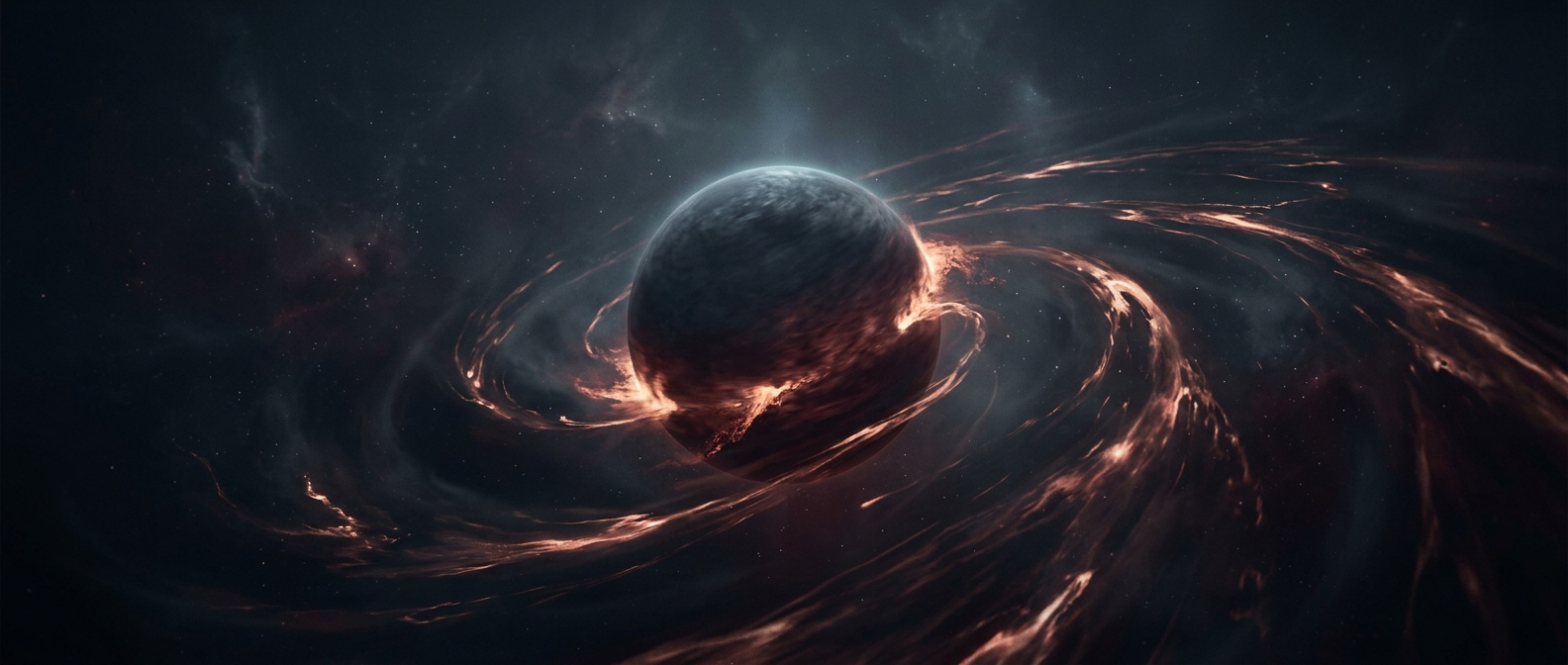
This is not the star bursting apart. The shedding is concentrated in a thin band around its middle, while gravity continues to hold most of the star together. The result can be a disk of gas orbiting the star’s equator, rather than matter streaming off equally in every direction.
From stellar surface to orbiting disk
Gas at the surface is already moving sideways with the star’s rotation. If it escapes, it carries that sideways motion with it, so it does not simply fly straight outward. Instead, it can settle into an orbit around the star. Continued loss from the equatorial region adds material to the disk, which can spread outward as the gas moves and interacts.
Astronomers call the balance between gravity and rotation centrifugal support: the tendency of rotating material to resist being pulled inward. It does not cancel gravity across the whole star. It matters most at the equator, explaining why the escape route is narrow even when the star is spinning extremely fast.
A visible clue to a star’s spin
In some rapidly rotating stars, the surrounding disk can affect the light we observe, offering evidence that material is being shed. The disk also means the star’s evolution is not controlled by gravity and nuclear energy alone: rotation can move mass and angular momentum—the quantity associated with how much rotation a body carries—out into the star’s surroundings.