Technology
Discover facts about technology. Small discoveries that change the way you see familiar things.
Technology

Acid paste prevents metal from oxidizing
Flux removes oxide from metal surfaces during soldering, helping molten solder form a solid bond. Without it, heat can quickly create oxidation that…
Discover more
Why luxury watches contain tiny rubies
Synthetic rubies act as tiny bearings in mechanical watches, reducing friction between moving gears. Their hardness helps the parts keep working without…
Discover more
A particle from space can flip a computer's bit
A high-energy particle can leave an electrical charge as it passes through a chip. If that charge changes a stored 0 into a 1, the machine receives wrong data…
Discover more
How blinking red light can carry sound
Optical audio sends digital sound as rapid pulses of red light through fiber-optic cable, avoiding electrical interference such as ground loops.
Discover more
Electronic music begins with geometric waves
Analog synthesizers use oscillators to generate electrical waveforms—sine, square, sawtooth, and triangle—which filters shape into musical notes.
Discover more
Your futuristic PC still follows a 1995 blueprint
ATX still fixes motherboard screw holes, ports, and expansion slots in standardized positions—a layout originally created for beige office PCs.
Discover more STACKY FOR IPHONE
A bigger world.
One discovery
at a time.
Keep discovering with Stacky. Interesting facts in an app that is always within reach.

Microscopic pits encode massive audio files
As the disc spins, a reader shines a laser at the track and translates changes in reflected light into binary code.
Discover more
Special alloys block invisible magnetic fields
Mu-metal’s high magnetic permeability gives magnetic fields an easier path through the alloy, guiding them around sensitive equipment rather than through it.
Discover more
How a vinyl record stores stereo sound
A stereo record’s single groove has a V-shaped cross-section, with the left channel carved into one wall and the right channel into the other. The needle…
Discover more
A tape drive can wear itself out waiting for data
Tape drives work best when data keeps arriving fast enough for continuous motion. A slow feed makes the drive stop, back up and restart, a pattern called…
Discover more
Swinging pendulums dictate perfect musical timing
A mechanical metronome uses an adjustable pendulum: sliding its weight closer to the pivot speeds up the beat, while moving it farther away slows it down.
Discover more
Why vinyl records cut the bass before pressing
Deep bass needs wider grooves and takes up more space on a record, so records are cut with reduced bass. A phono preamp boosts it back during playback.
Discover more
Magnetic pulses lock motors into rigid steps
Stepper motors use toothed electromagnets to divide a rotation into hundreds of distinct steps, locking the shaft at precise angles instead of spinning freely.
Discover more
Impurities make silicon incredibly useful
Pure silicon is a poor conductor, so manufacturers add elements such as phosphorus or boron to tune its electrical behavior for circuits.
Discover more
Electromagnets mechanically throw heavy switches
A relay uses a low-voltage signal to energize an electromagnet, which pulls a metal contact closed and switches a much larger electrical load without sending…
Discover more
Chip factories are pristine beyond belief
Chip-factory cleanrooms filter out particles because even a speck of dust can ruin microchips. Workers wear full-body suits to keep skin flakes and other…
Discover more
How your finger activates a flat touch button
A capacitive panel detects the change in its electric field when your conductive finger approaches. That shift in capacitance triggers the button without a…
Discover more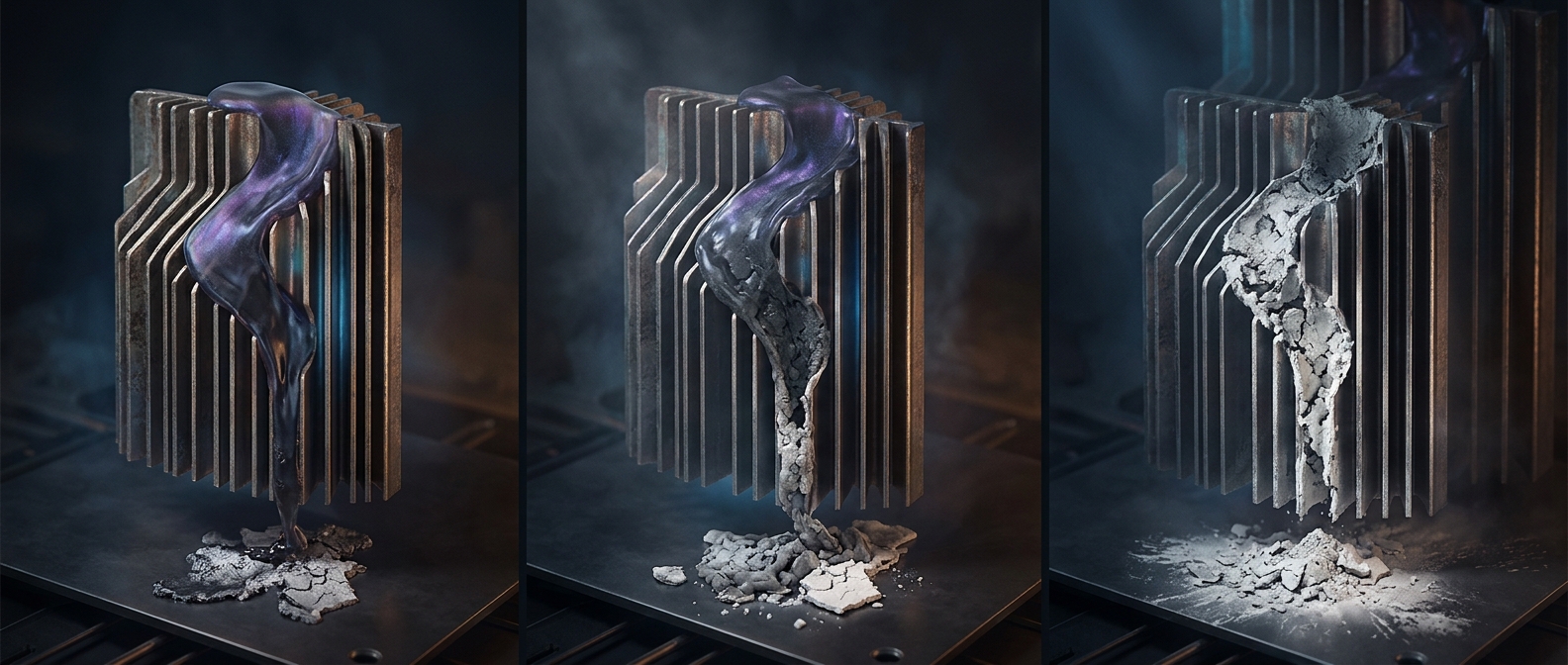
Thermal paste fills gaps that look flat to your eyes
A processor and its cooler have microscopic surface irregularities that would otherwise trap insulating air. Paste bridges those gaps. Drying, separation, or…
Discover more
Two metals and electricity can make one side cold
The Peltier effect makes one side of a junction cool while the other heats up when current passes through it, with no moving parts.
Discover more
How sound travels through your skull
Bone-conduction devices vibrate the cheekbones, sending sound through the skull to the inner ear while bypassing the ear canal and eardrums.
Discover more
Multiple plastic layers double disc capacity
A dual-layer disc stores data on two layers: the drive focuses its laser through the semi-reflective top layer to read the more reflective layer beneath it,…
Discover more
Why some cows ride a giant carousel to get milked
A rotating platform lets workers milk many cows in sequence: each cow steps on, gets fitted with suction cups, and steps off after a circuit.
Discover more
Polymerase chain reactions copy DNA millions of times
A thermal cycler repeatedly heats and cools a DNA sample, prompting enzymes to copy it. That can turn a tiny crime-scene sample into billions of copies for…
Discover more
Modern greenhouses use enriched carbon dioxide atmospheres
They pump extra carbon dioxide into enclosed growing spaces because plants use it to grow, creating an atmosphere richer in CO₂ than ordinary air.
Discover more